

Acetyl Tetrapeptide-2 is a synthetic N-acetylated tetrapeptide used primarily as a cosmetic peptide active. Chemically, it consists of four amino-acid residues—lysine, aspartic acid, valine, and tyrosine—with an acetyl group attached to the N-terminus. Its peptide sequence is Ac-Lys-Asp-Val-Tyr-OH (Ac-KDVY).
1. Chemical identity
| Property | Acetyl Tetrapeptide-2 |
| INCI name | Acetyl Tetrapeptide-2 |
| Common abbreviation | Ac-KDVY |
| Peptide sequence | Ac-Lys-Asp-Val-Tyr-OH |
| CAS No. | 757942-88-4 |
| Molecular formula | C₂₆H₃₉N₅O₉ |
| Molecular weight | 565.6 g/mol |
| IUPAC name | N-acetyl-L-lysyl-L-α-aspartyl-L-valyl-L-tyrosine |
| InChIKey | ITIMHIATVYROGF-XWUOBKMESA-N |
| Physical form | Solid, typically white to off-white |
| Charge | Neutral as the free compound |
| Stereocenters | 4 defined stereocenters |
These structural identifiers are reported by PubChem and the U.S. National Center for Advancing Translational Sciences.
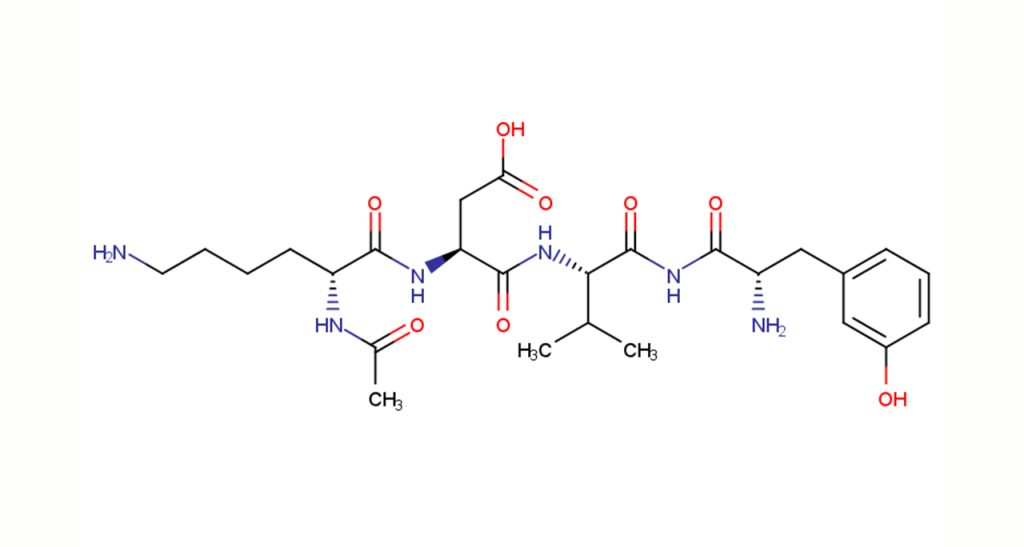
2. Molecular structure
The backbone can be represented as:
Ac–Lys–Asp–Val–Tyr–OH
or, using one-letter amino-acid notation:
Ac-KDVY-OH
The four residues contribute different chemical characteristics:
- Lysine (K): contains a terminal primary amino group, providing a basic/polar site.
- Aspartic acid (D): contains an additional carboxylic acid group, contributing acidic character.
- Valine (V): has a branched, hydrophobic isopropyl side chain.
- Tyrosine (Y): contains an aromatic phenyl ring bearing a phenolic hydroxyl group.
- N-terminal acetyl group: caps the peptide’s terminal amino group and changes its physicochemical behavior compared with the corresponding unacetylated peptide.
The molecule therefore contains amide peptide bonds, carboxylic acid groups, an amino group, a phenolic hydroxyl group, and an N-acetyl group. PubChem gives the corresponding SMILES representation and confirms the Ac-KDVY sequence.
3. Molecular formula and molecular weight
The free peptide has the molecular formula:
C₂₆H₃₉N₅O₉
with a calculated molecular weight of approximately 565.6 g/mol.
The relatively high molecular weight compared with individual amino acids reflects the combination of four amino-acid residues plus the N-acetyl group.
4. Functional groups
Acetyl Tetrapeptide-2 contains several chemically important functional groups:
- Peptide amide bonds (–CO–NH–) — form the peptide backbone.
- Carboxylic acid groups (–COOH) — contribute polarity and potential ionization.
- Primary amine (–NH₂) — associated with the lysine side chain.
- Phenolic hydroxyl (Ar–OH) — supplied by tyrosine.
- Aromatic ring — supplied by tyrosine.
- Acetyl group (CH₃CO–) — caps the N-terminus.
Consequently, the molecule has a mixture of hydrophilic/polar and hydrophobic regions, which is characteristic of many bioactive peptides.
5. Stereochemistry
Acetyl Tetrapeptide-2 is not simply an arbitrary chain of amino acids. The biologically relevant compound has defined stereochemistry corresponding to the L-amino-acid configuration. NCATS reports four defined stereocenters out of four.
This stereochemical arrangement is important because peptide–protein interactions are highly dependent on three-dimensional configuration.
6. Physical properties
Acetyl Tetrapeptide-2 is generally encountered as a solid, white to off-white material. A commercial analytical reference lists it as a solid and recommends protection from moisture during storage.
Its physicochemical behavior is influenced strongly by its peptide nature:
- Appearance: white to off-white solid
- Molecular weight: ~565.6 g/mol
- Polarity: relatively high because of multiple amide, carboxyl, amino, and hydroxyl groups
- Hydrogen bonding: substantial hydrogen-bonding capacity
- Water behavior: dependent on pH, concentration, salt form, and formulation environment
- Organic-solvent behavior: reported to be soluble in DMSO; specific solubility varies with preparation and salt form.
Because peptides can exist in different ionic states, solubility should not be inferred solely from the molecular formula. Formulators need to consider pH and whether the material is supplied as the free peptide or as a salt.
7. Free peptide versus salt forms
An important distinction is that Acetyl Tetrapeptide-2 itself should not be confused with its acetate or trifluoroacetate salts.
For example, PubChem separately identifies Acetyl Tetrapeptide-2 acetate, with formula C₂₈H₄₃N₅O₁₁ and molecular weight about 625.7 g/mol.
Commercial research material may also be supplied as a trifluoroacetate salt, in which case the counterion contributes additional mass and affects the material’s analytical and formulation properties.
8. Structural significance for cosmetics
The structure is particularly relevant to its use as a cosmetic peptide:
Acetyl group → peptide stability/terminal modification
↓
Lys–Asp–Val–Tyr sequence → molecular recognition
↓
Polar + charged groups → aqueous/formulation interactions
↓
Tyrosine aromatic/phenolic group + valine hydrophobic group → mixed amphiphilic character
Thus, Acetyl Tetrapeptide-2 is a small, structurally defined signaling-type peptide rather than a conventional moisturizing polymer. Its relatively small size makes it substantially different from macromolecular ingredients such as collagen or hyaluronic acid.
In summary: Acetyl Tetrapeptide-2 is the N-acetylated tetrapeptide Ac-KDVY, with the chemical formula C₂₆H₃₉N₅O₉ and molecular weight approximately 565.6 g/mol. Its structure combines four L-amino-acid residues, four defined stereocenters, multiple peptide/ionic functional groups, a tyrosine aromatic ring, and an N-terminal acetyl cap. These structural features determine its solubility, hydrogen-bonding behavior, ionization, formulation compatibility, and biological recognition.