

5-Amino 1MQ (5-amino-1-methylquinolinium) is a synthetic small-molecule research compound developed as a selective inhibitor of the metabolic enzyme Nicotinamide N-methyltransferase (NNMT). It is widely studied in metabolic biology, obesity research, and NAD⁺ regulation.
Origin of 5-Amino 1MQ
1. Academic development
5-Amino 1MQ was developed through medicinal chemistry research aimed at understanding why NNMT is elevated in obesity and metabolic disease.
Key origin points:
- Developed by research teams at the University of Texas Medical Branch
- Key researchers include Watowich and Neelakantan
- Originated from quinolinium-based compound libraries
- Identified through structure–activity relationship (SAR) screening
2. Why it was created
Researchers were investigating NNMT because:
- NNMT is often overexpressed in obese fat tissue
- It consumes nicotinamide (vitamin B3 derivative) and methyl groups
- This reduces availability for NAD⁺ production and cellular energy metabolism
5-Amino 1MQ was designed to:
- Block NNMT activity
- Preserve NAD⁺ precursors
- Improve metabolic efficiency in fat tissue
3. Timeline of discovery
- 2017: First identification as a potent NNMT inhibitor in chemical screening studies
- 2018: Animal studies showed reduced fat mass and improved metabolic markers in obese mice
- Ongoing: Continued use as a research tool compound in metabolic and aging studies
Chemical and Physical Properties
Chemical identity
- Name: 5-Amino-1-methylquinolinium
- Class: Quinolinium-based small molecule (not a peptide)
- Formula (cation): C₁₀H₁₁N₂⁺
- Common salt forms: iodide (most common), chloride
Molecular characteristics
Molecular weight:
- ~159 g/mol (free cation)
- ~286 g/mol (iodide salt form)
Structure type:
Aromatic heterocycle with:
- Quinoline ring system
- Permanent positive charge (quaternary-like nitrogen)
- 5-position amino group
Physical properties
Appearance
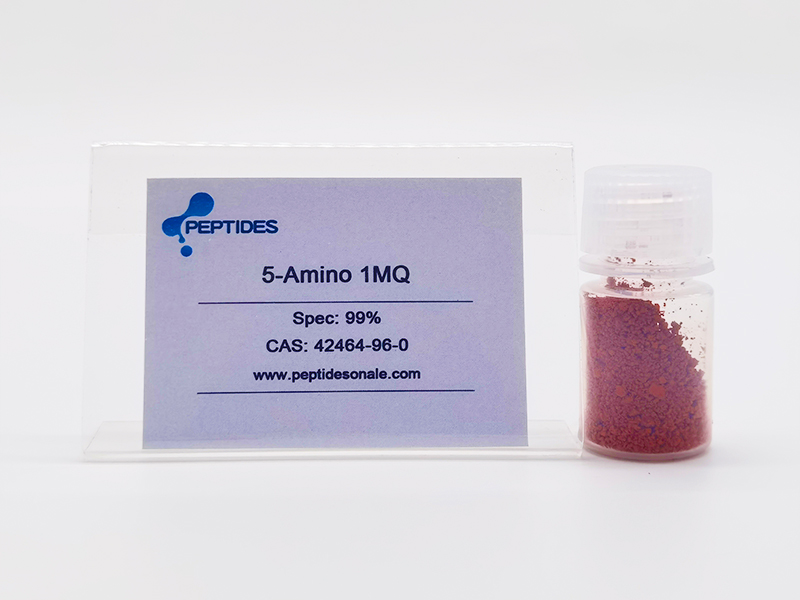
- Off-white to light yellow or orange crystalline powder
Solubility
- Highly water soluble
- Soluble in polar solvents (e.g., DMSO)
- Poor solubility in oils or non-polar solvents
Charge behavior
- Permanently positively charged (cationic molecule)
- Exists as a salt with iodide or chloride
Stability
- Chemically stable under normal storage conditions
- More stable than peptides (no enzymatic degradation risk)
Lipophilicity
- Moderate (aromatic structure increases membrane interaction, but charge increases water affinity)
Functional Properties (Why its structure matters)
The chemical structure directly explains its biological function:
- Quinolinium ring → enables binding to NNMT enzyme pocket
- Positive charge → enhances interaction with active site residues
- Amino group → increases potency and selectivity
- Small molecular size → supports cellular permeability
This combination makes it a high-affinity NNMT inhibitor in preclinical models.
Biological Role (Context of its function)
Although not a natural compound, it interacts with a key metabolic pathway:
Target enzyme: NNMT
NNMT normally:
- Converts nicotinamide → 1-methylnicotinamide
- Uses methyl groups from SAM
- Reduces NAD⁺ precursor availability
By inhibiting NNMT, 5-Amino 1MQ:
- Preserves nicotinamide for NAD⁺ production
- Reduces methyl-group consumption
- Supports mitochondrial energy metabolism
Research Status
- Type: Research-use-only compound
- Human approval: None (not FDA-approved)
- Evidence base: Preclinical (cell + animal studies only)
- Regulatory status: Not approved for medical use; classified as a non-approved research chemical in many contexts

Key Summary
5-Amino 1MQ is:
A synthetic quinolinium small molecule
Developed at UTMB (University of Texas Medical Branch)
Designed to inhibit NNMT, a metabolic enzyme linked to obesity
Structurally characterized by:
- Aromatic quinoline core
- Permanent positive charge
- Amino substitution at position 5
Its physical and chemical properties make it:
- Highly water-soluble
- Stable
- Cell-permeable
- Suitable for metabolic enzyme targeting in research models
Bottom Line
5-Amino 1MQ originates from academic medicinal chemistry research into metabolic disease, and its properties reflect a carefully designed small, charged, water-soluble NNMT inhibitor intended to modulate NAD⁺ and fat metabolism pathways in experimental systems.