

Acetyl Tetrapeptide-3 is a synthetic biomimetic peptide used primarily in cosmetic skin- and hair-care formulations. It is particularly associated with supporting the appearance of skin firmness, extracellular-matrix integrity, and hair/scalp condition. It is often discussed as a peptide that may help support the dermal matrix and improve the visual signs of aging.
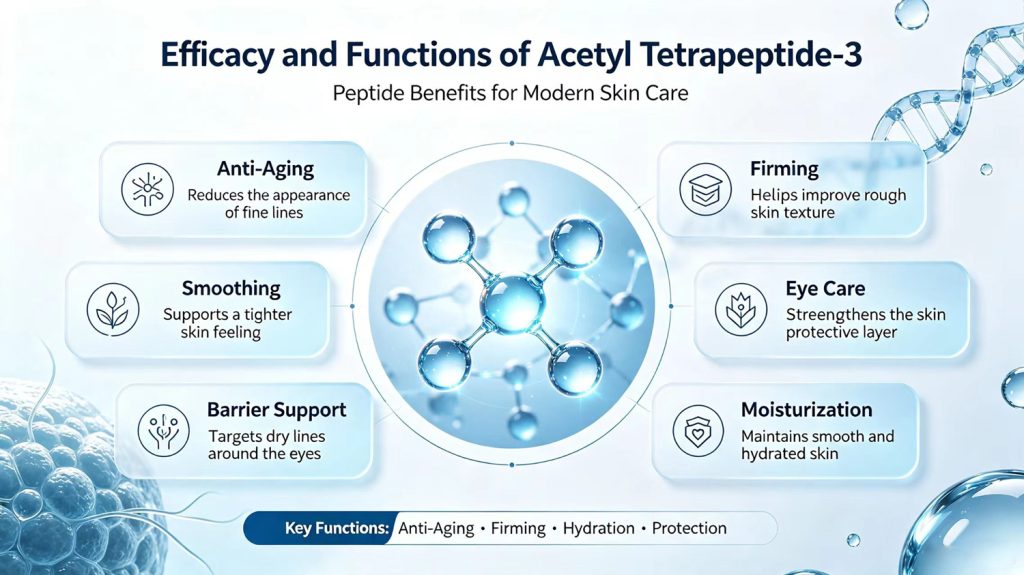
1. Main efficacy
| Efficacy | How it may help |
| Skin-firming support | Helps support the extracellular matrix and may improve the appearance of skin firmness and elasticity. |
| Anti-aging support | May reduce the appearance of fine lines and loss of skin resilience when used consistently. |
| Collagen/ECM support | Peptide-based signaling may support processes associated with extracellular-matrix proteins. |
| Skin remodeling | May contribute to improved organization and maintenance of the dermal matrix. |
| Moisture and smoothness | By supporting the skin barrier and matrix environment, it can contribute to smoother-looking skin. |
| Hair/scalp care | Used in some hair-oriented peptide systems intended to improve scalp condition and the appearance of fuller, healthier hair. |
2. Skin-care functions
A. Supports extracellular-matrix integrity
Acetyl Tetrapeptide-3 is primarily valued for its potential interaction with processes involved in maintaining the skin’s extracellular matrix. A healthier matrix provides structural support for collagen- and elastin-containing tissues.
B. Firming and elasticity
By supporting dermal structural components, the peptide may help skin appear firmer, more elastic, and less lax. This makes it useful in anti-aging creams, serums, and eye-area products.
C. Fine-line and wrinkle appearance
It is generally used as a long-term supportive anti-aging active, rather than as an immediate wrinkle-relaxing ingredient. Improvements, when they occur, are expected to develop with continued cosmetic use.
D. Skin texture
Improved matrix support and hydration can contribute to a smoother and more refined skin appearance.
3. Hair-care functions
Acetyl Tetrapeptide-3 is also encountered in hair/scalp cosmetic products, particularly peptide complexes marketed for strengthening or improving the appearance of thinning or weakened hair.
Its proposed cosmetic roles include:
- Supporting the condition of the hair follicle/scalp environment
- Helping improve the appearance of hair density and fullness
- Supporting the appearance of stronger-looking hair
- Complementing other hair-conditioning and scalp-care ingredients
Importantly, cosmetic evidence for actual hair-growth stimulation should not be equated with evidence for treating androgenetic alopecia or other medical hair-loss disorders.
4. Mechanistic concept
The peptide is generally considered a biomimetic/signaling peptide. Rather than functioning like a conventional moisturizer or occlusive agent, its proposed benefit comes from influencing cellular or extracellular-matrix processes.
A simplified concept is:
Acetyl Tetrapeptide-3 → peptide signaling → support of extracellular-matrix/structural processes → improved skin structural appearance → firmer and smoother-looking skin
The precise biological mechanism and magnitude of effects depend strongly on the formulation, concentration, delivery system, and accompanying ingredients.
5. Advantages as a cosmetic active
- Can be used in anti-aging formulations
- Suitable for serums, creams, lotions, and specialized peptide products
- Generally used at relatively low concentrations
- Can complement other anti-aging ingredients
- Offers a different mechanism from exfoliating acids or retinoids
- May be useful in both skin-care and hair/scalp-care formulations
6. Evidence limitations
A key distinction is that cosmetic efficacy claims for Acetyl Tetrapeptide-3 are not equivalent to clinical evidence for a drug. Much of the ingredient-specific evidence comes from supplier-sponsored testing, proprietary ingredient systems, in-vitro studies, or small cosmetic-use studies. Therefore, claims such as substantial collagen regeneration or clinically meaningful hair growth should be interpreted cautiously.
In summary: Acetyl Tetrapeptide-3 is best viewed as a supportive cosmetic peptide for skin structural integrity, firmness, elasticity, and anti-aging appearance, with additional applications in hair/scalp formulations. It is more appropriate to describe it as helping improve the appearance and condition of skin and hair than as a proven therapeutic treatment for wrinkles or hair loss.