

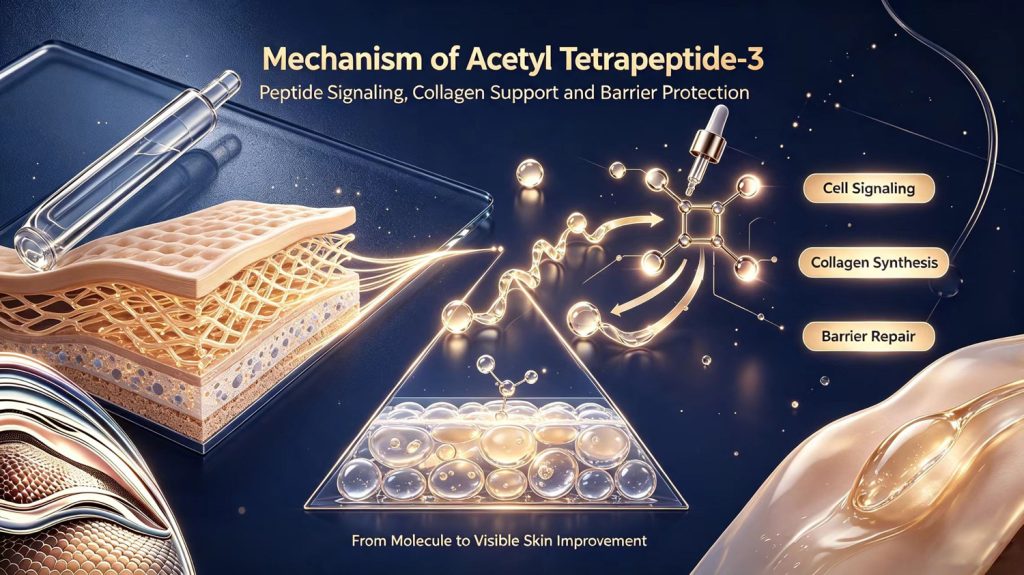
Acetyl Tetrapeptide-3 (Ac-KGHK) is a synthetic biomimetic signal peptide primarily studied as a hair/scalp-supporting cosmetic active. Its best-supported mechanism is not direct hormonal blockade, but remodeling and strengthening of the extracellular matrix (ECM) surrounding the hair follicle, particularly the dermal papilla and follicular anchoring structures.
1. Stimulates extracellular-matrix protein synthesis
The central mechanism is stimulation of proteins that form the structural environment around the follicle.
Studies have reported increased production of:
- Type III collagen — contributes to connective-tissue strength and organization.
- Laminin — an important basement-membrane glycoprotein involved in cell adhesion, migration and follicular architecture.
- Collagen VII — associated with the dermal–epidermal junction and structural attachment.
In human fibroblast experiments, Acetyl Tetrapeptide-3 increased collagen III and laminin production, while studies in human skin explants found increased collagen VII expression.
2. Strengthens the follicular microenvironment
The hair follicle is not simply a hair-producing tube; it depends heavily on its surrounding ECM and dermal papilla for structural support and signaling.
A simplified mechanism is:
Acetyl Tetrapeptide-3 → increased ECM protein synthesis → stronger follicular matrix → improved follicle structural support/anchoring
This is why the peptide is often described as an ECM-supporting or follicle-anchoring peptide, rather than simply a conventional “hair-growth stimulant.”
3. Supports dermal-papilla structure
The dermal papilla is a specialized structure at the base of the follicle that provides important signals controlling follicular growth and cycling.
Increasing ECM components around dermal-papilla cells can help maintain the structural environment required for normal follicular activity. Experimental work has reported stimulation of collagen III synthesis in human dermal papilla cells.
A useful conceptual model is:
Acetyl Tetrapeptide-3
↓
ECM stimulation
↓
↑ collagen III + ↑ laminin + ↑ collagen VII
↓
better follicular structural integrity
↓
better hair-follicle anchoring and support
4. May help counter follicular miniaturization indirectly
In androgenetic alopecia, susceptible follicles progressively become smaller and produce thinner hairs. Acetyl Tetrapeptide-3 is proposed to address one component of this process—the deteriorating follicular microenvironment—rather than directly eliminating the androgen signal.
This distinction is important: Acetyl Tetrapeptide-3 should not be considered equivalent to a clinically established DHT-lowering drug.
Some commercial descriptions attribute anti-DHT activity to Acetyl Tetrapeptide-3 itself, but the better-supported experimental evidence for the peptide centers on ECM protein stimulation. The anti-DHT component of formulations such as Capixyl is more appropriately associated with biochanin A from red clover, rather than assuming that Acetyl Tetrapeptide-3 directly inhibits 5α-reductase.
5. Potential anti-inflammatory contribution
There is also evidence from combination experiments that formulations containing Acetyl Tetrapeptide-3 and red-clover-derived ingredients can reduce inflammatory signaling such as IL-8 under experimentally induced inflammatory conditions. However, this should be interpreted as supportive/secondary evidence, particularly because many studies evaluate the peptide together with other ingredients.
6. May influence hair-growth signaling indirectly
More recent experimental work has found that combinations containing Acetyl Tetrapeptide-3 can affect hair-follicle-related signaling pathways. For example, a nanoliposomal combination containing Acetyl Tetrapeptide-3, copper peptide and myristoyl pentapeptide-4 increased VEGF and β-catenin and reduced TGF-β1 in an androgen-related mouse model. However, because several peptides were present simultaneously, these effects cannot be assigned specifically to Acetyl Tetrapeptide-3.
Overall mechanism
| Mechanistic level | Proposed effect |
| Primary target | Follicular ECM / dermal-papilla environment |
| Collagen III | ↑ synthesis |
| Laminin | ↑ synthesis |
| Collagen VII | ↑ expression in skin-explant experiments |
| Follicular anchoring | Potentially strengthened |
| Dermal-papilla environment | Structurally supported |
| Inflammatory signaling | Possible reduction in combination formulations |
| DHT | Not the primary demonstrated mechanism of the peptide |
| Hair growth | Potential indirect support through follicular structural maintenance |
Bottom line
Acetyl Tetrapeptide-3 works primarily as an extracellular-matrix-supporting signal peptide. Its most credible mechanism is to stimulate collagen III, laminin and related structural proteins, thereby improving the physical and biochemical environment surrounding the hair follicle. This may help maintain follicular size, anchoring and growth-supportive conditions.
The important caveat is that much of the mechanistic evidence is in vitro, ex vivo, or from multi-ingredient formulations, so its mechanism is considerably better established at the cellular/ECM level than its ability to produce clinically meaningful hair regrowth in humans.