

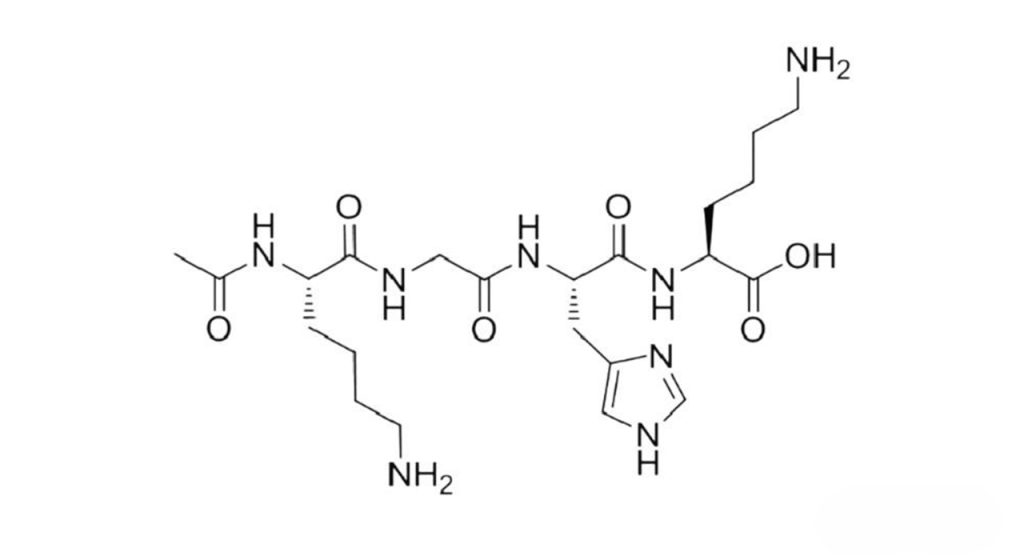
Acetyl Tetrapeptide-3 is a synthetic biomimetic tetrapeptide used primarily in cosmetic and hair/scalp formulations. Chemically, it is an N-acetylated tetrapeptide composed of lysine, glycine, histidine, and lysine, with a C-terminal amide. Its peptide sequence is Ac-Lys-Gly-His-Lys-NH₂ (Ac-KGHK-NH₂).
1. Chemical structure
The structure can be represented as:
Ac-Lys-Gly-His-Lys-NH₂
where:
- Ac = N-acetyl group
- Lys = L-lysine
- Gly = glycine
- His = L-histidine
- Lys = L-lysine
- NH₂ = C-terminal amide
The acetyl group is attached to the amino terminus of the first lysine, while the terminal carboxyl group is converted into an amide. These modifications help distinguish Acetyl Tetrapeptide-3 from the unmodified peptide and affect its physicochemical characteristics. PubChem identifies the compound as N-acetyl-L-lysyl-glycyl-L-histidyl-L-lysinamide.
Molecular formula: C₂₂H₃₉N₉O₅
Molecular weight: 509.6 g/mol
CAS number: 827306-88-7
PubChem CID: 11752568
2. Important structural features
| Property | Acetyl Tetrapeptide-3 |
| Peptide type | Tetrapeptide |
| Sequence | Ac-KGHK-NH₂ |
| Amino acids | Lysine–Glycine–Histidine–Lysine |
| N-terminal modification | Acetyl |
| C-terminal modification | Amide |
| Molecular formula | C₂₂H₃₉N₉O₅ |
| Molecular weight | 509.6 g/mol |
| Exact/monoisotopic mass | 509.3074 Da |
| Hydrogen-bond donors | 8 |
| Hydrogen-bond acceptors | 8 |
| Rotatable bonds | 18 |
| Topological polar surface area | ~240 Ų |
| XlogP3-AA | −3 |
| Stereocenters | 3 |
The high number of hydrogen-bonding sites and the very low calculated XlogP indicate that the molecule is strongly polar and hydrophilic, rather than lipid-soluble.
3. Physical properties
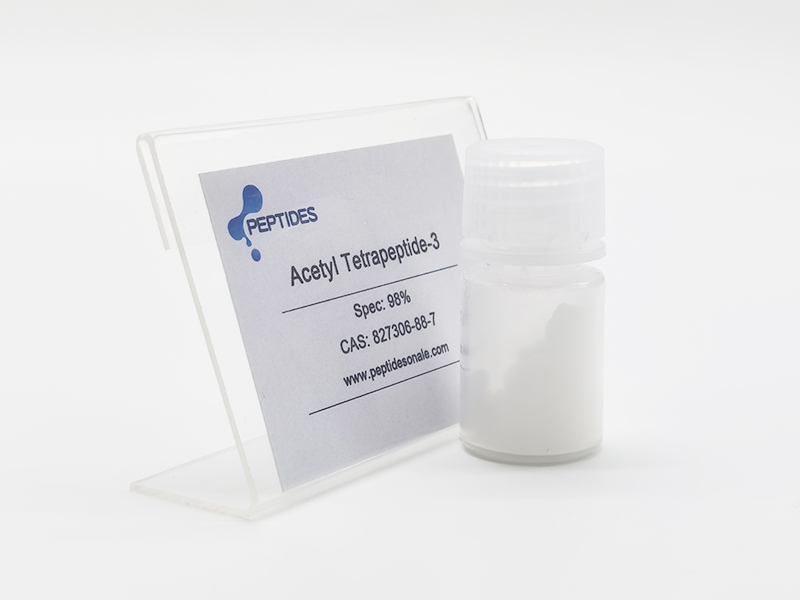
Physical form: Acetyl Tetrapeptide-3 is generally encountered as a solid peptide material or as part of an aqueous/cosmetic peptide preparation. Commercial research material is supplied as a solid.
Water solubility: The peptide has appreciable aqueous solubility. One commercial specification reports approximately 10 mg/mL in water, although actual solubility can vary with pH, ionic strength, concentration, purity, and whether the material is supplied as the acetate salt.
Polarity: Its calculated XlogP3-AA of −3 reflects a highly hydrophilic molecular character. The numerous amino, amide, imidazole, and carbonyl groups contribute substantially to its polarity.
Hydrogen bonding: It has 8 hydrogen-bond donors and 8 hydrogen-bond acceptors. This contributes to strong interactions with water and other polar components but also makes passive penetration through highly lipophilic biological barriers less favorable.
Conformational flexibility: PubChem reports 18 rotatable bonds and notes that conformer generation is disallowed because the molecule is too flexible for that calculation. This is typical of short peptide molecules, which can adopt multiple conformations in solution.
4. Acetyl Tetrapeptide-3 acetate vs. free peptide
A formulation or supplier may provide Acetyl Tetrapeptide-3 as an acetate salt rather than the parent compound.
The parent compound has:
C₂₂H₃₉N₉O₅ — 509.6 g/mol
The acetate form contains acetic acid as a counterion and is reported by PubChem as:
C₂₄H₄₃N₉O₇ — 569.7 g/mol.
Therefore, 509.6 g/mol and 569.7 g/mol should not be treated as contradictory values; they refer to the parent peptide and acetate form, respectively.
5. What the structure means for cosmetic formulation
The structure has several practical implications:
- Highly hydrophilic: The peptide favors aqueous phases rather than oils.
- Limited lipid affinity: Its very low calculated logP makes direct partitioning into lipid-rich environments relatively unfavorable.
- pH-sensitive ionization: Lysine side chains and the histidine imidazole group can become protonated depending on formulation pH.
- Potential peptide instability: Like other peptides, it can be susceptible to hydrolysis or degradation under unfavorable pH, temperature, or storage conditions.
- Salt form matters: Acetate and other formulation forms can influence solubility, pH behavior, and the apparent molecular weight of the supplied raw material.
6. Structural significance in cosmetics
Acetyl Tetrapeptide-3 is particularly interesting because its KGHK peptide sequence contains lysine and histidine residues, giving it a highly polar, potentially ionizable structure. The molecule is designed as a biomimetic peptide, and it is used in cosmetic products intended to support the appearance and condition of hair and scalp.
Importantly, chemical structure alone does not establish clinical hair-growth efficacy. The physicochemical characteristics explain how the ingredient behaves in a formulation, whereas efficacy depends on concentration, delivery system, biological activity, formulation, and supporting experimental evidence.
In summary: Acetyl Tetrapeptide-3 is a small, highly polar, flexible biomimetic tetrapeptide with the sequence Ac-KGHK-NH₂, molecular formula C₂₂H₃₉N₉O₅, and molecular weight 509.6 g/mol. Its high hydrogen-bonding capacity, low calculated lipophilicity, and aqueous solubility are its most important physicochemical characteristics for cosmetic formulation.