

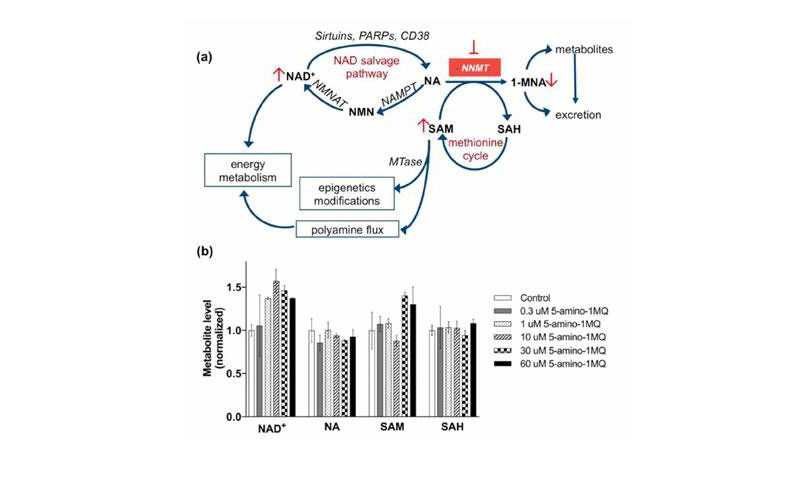
5-Amino 1MQ is primarily a research compound being investigated for its ability to inhibit the enzyme Nicotinamide N-methyltransferase (NNMT). Its potential applications are centered around metabolism, obesity, and cellular energy regulation. Most evidence comes from laboratory and animal studies rather than human clinical trials.
1. Obesity and Weight Management Research
The most extensively studied application is the treatment of obesity and excess fat accumulation.
Researchers have investigated 5-Amino 1MQ for its ability to:
- Reduce white adipose tissue (body fat)
- Decrease fat-cell size
- Increase energy expenditure
- Promote fat oxidation without significantly affecting food intake
Animal studies have shown reductions in body weight and fat mass through metabolic effects rather than appetite suppression.
2. Metabolic Syndrome Research
5-Amino 1MQ is being explored as a potential tool for improving metabolic dysfunction associated with:
- Insulin resistance
- Elevated blood glucose
- Dyslipidemia
- Central obesity
NNMT is often overexpressed in obesity and metabolic syndrome, making it an attractive therapeutic target.

3. NAD⁺ Enhancement and Cellular Energy
A major application is in the study of NAD⁺ metabolism.
By inhibiting NNMT, 5-Amino 1MQ may:
- Preserve nicotinamide
- Increase NAD⁺ availability
- Support mitochondrial energy production
- Enhance activity of NAD⁺-dependent enzymes such as sirtuins
This has generated interest in longevity and cellular-energy research.
4. Mitochondrial Function Research
Researchers are studying whether NNMT inhibition can improve:
- Mitochondrial efficiency
- Fatty-acid oxidation
- Cellular ATP production
- Overall metabolic flexibility
Improved mitochondrial activity is thought to be one mechanism behind the observed fat-loss effects in animal models.
5. Insulin Sensitivity and Diabetes Research
Preclinical studies suggest that NNMT inhibition may:
- Improve insulin sensitivity
- Enhance glucose tolerance
- Support glucose utilization
As a result, 5-Amino 1MQ is being investigated as a possible future adjunct for metabolic disorders such as type 2 diabetes. However, human evidence is still lacking.
6. Fatty Liver Disease Research
Because obesity, insulin resistance, and fatty liver disease are closely related, researchers are examining whether 5-Amino 1MQ can:
- Reduce liver fat accumulation
- Improve hepatic metabolism
- Lower metabolic stress in the liver
This application remains in the early research stage.
7. Healthy Aging and Longevity Research
Potential anti-aging applications are based on:
- Increased NAD⁺ availability
- Enhanced mitochondrial function
- Activation of cellular repair pathways
Current evidence is largely theoretical and preclinical, and no human studies have demonstrated lifespan extension.
8. Body Recomposition Research
Some researchers are interested in 5-Amino 1MQ for:
- Reducing fat mass
- Preserving lean muscle mass
- Improving body composition
This has led to investigation of its use alongside other metabolic interventions in experimental settings. Community discussions often mention combining it with GLP-1–based therapies, though no controlled human studies have validated such combinations.
Summary Table
| Research Area | Current Evidence |
| Obesity/Fat Loss | Strongest preclinical evidence |
| Metabolic Syndrome | Moderate preclinical evidence |
| NAD⁺ Enhancement | Moderate mechanistic evidence |
| Mitochondrial Function | Moderate preclinical evidence |
| Insulin Sensitivity | Moderate preclinical evidence |
| Fatty Liver Disease | Early-stage evidence |
| Healthy Aging | Theoretical/early-stage |
| Body Recomposition | Preliminary evidence |
Bottom Line
The primary applications of 5-Amino 1MQ are currently in obesity, metabolic syndrome, NAD⁺ metabolism, mitochondrial function, and insulin-sensitivity research. Among these, fat reduction and metabolic enhancement have the strongest experimental support. However, 5-Amino 1MQ remains an investigational compound, and its efficacy and long-term safety in humans have not yet been established through large clinical trials.