

Acetyl Tetrapeptide-5 is a synthetic tetrapeptide derivative widely used as a cosmetic active, particularly in products targeting under-eye puffiness, dark circles, and signs of fatigue. It is also known by the INCI name Acetyl Tetrapeptide-5 and is commonly associated with the trade ingredient Eyeseryl®.
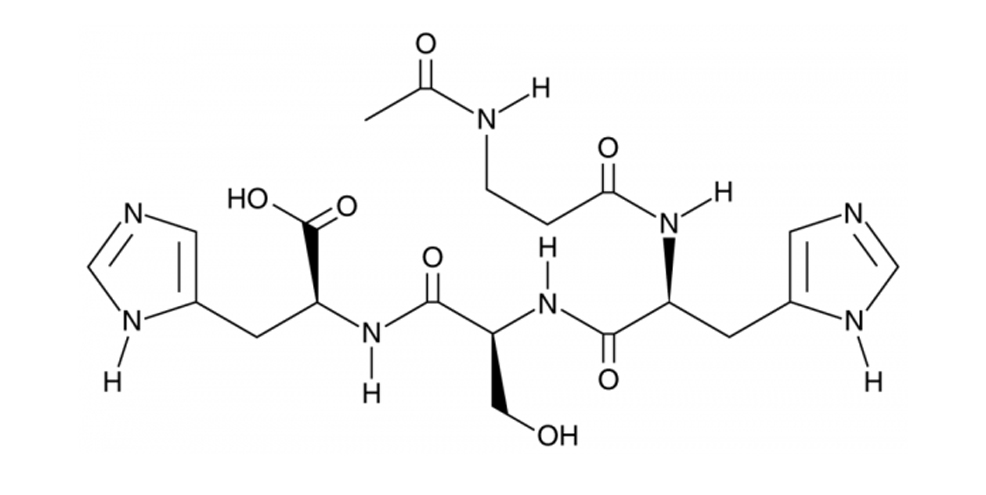
1. Chemical structure
Acetyl Tetrapeptide-5 consists of a four-amino-acid peptide chain with an acetyl group attached to the N-terminal end.
A commonly represented sequence is:
N-Acetyl-Lys-Asp-Val-Tyr-NH₂
or, using one-letter amino-acid notation:
Ac-Lys-Asp-Val-Tyr-NH₂
Its structure therefore contains:
- Acetyl group (CH₃CO–): modifies the N-terminal amino group.
- Lysine (Lys, K): a basic amino acid with an ε-amino side chain.
- Aspartic acid (Asp, D): contributes a carboxyl-containing acidic side chain.
- Valine (Val, V): a branched-chain, relatively hydrophobic amino acid.
- Tyrosine (Tyr, Y): contains an aromatic phenolic ring.
- C-terminal amidation (–CONH₂): gives the peptide a modified C-terminus.
The combination of acetylation and terminal amidation changes the peptide’s charge, stability, solubility, and biological behavior compared with an unmodified tetrapeptide.
2. Chemical characteristics
| Property | Acetyl Tetrapeptide-5 |
| Chemical class | Synthetic acetylated tetrapeptide |
| Peptide length | 4 amino acids |
| Approximate sequence | Ac-Lys-Asp-Val-Tyr-NH₂ |
| Terminal modifications | N-acetylated and C-terminally amidated |
| Molecular type | Small peptide |
| Functional groups | Amide, carboxyl, hydroxyl, amino-derived groups |
| Appearance | Typically supplied as a white/off-white powder or as a formulated aqueous solution |
| Water solubility | Generally water-compatible; commercial preparations may have substantially different solubility depending on carrier |
| Charge characteristics | Amphoteric/ionizable because of acidic and basic functional groups |
| Stability | Sensitive to factors such as pH, temperature, oxidation, and enzymatic degradation |
3. Molecular weight
The molecular weight reported for Acetyl Tetrapeptide-5 is approximately 500 Da, although the precise value depends on the exact chemical form and specification used by the supplier.
Because cosmetic raw materials may be supplied as aqueous solutions, blends, or standardized preparations, the molecular weight of the pure peptide should not be confused with the concentration of the commercial ingredient.
4. Physical properties
Appearance: Pure Acetyl Tetrapeptide-5 is generally encountered as a white to off-white powder. Cosmetic suppliers may instead provide it as a diluted liquid solution.
Solubility: The peptide is generally compatible with water-based cosmetic formulations. Its actual solubility depends on pH, ionic strength, temperature, concentration, and the presence of other formulation ingredients.
Hygroscopicity: Like many small peptides, it can have an affinity for moisture. Appropriate packaging and storage conditions are therefore important for maintaining raw-material quality.
pH sensitivity: The peptide contains ionizable groups, so its charge state changes with pH. Formulators generally need to keep the finished product within a pH range compatible with both the peptide and the rest of the formulation.
Thermal stability: Peptides can undergo degradation when exposed to prolonged elevated temperatures. Acetyl Tetrapeptide-5 is therefore generally handled using controlled processing temperatures rather than prolonged high-temperature exposure.
5. Why the structure matters
The molecular design is important for its cosmetic function.
N-acetylation helps modify the peptide’s physicochemical characteristics and can increase resistance to certain enzymatic processes compared with an unmodified N-terminal peptide.
C-terminal amidation eliminates the terminal carboxyl group, further changing the molecule’s charge distribution and peptide stability.
The Lys-Asp-Val-Tyr sequence provides the specific molecular arrangement associated with Acetyl Tetrapeptide-5’s biological activity. The peptide is intended to act as a cosmetic signaling/functional peptide, rather than simply serving as a source of amino acids.
6. Structural relationship to its cosmetic function
Acetyl Tetrapeptide-5 has been investigated particularly for eye-area cosmetic applications. Its proposed effects include influencing processes associated with:
- fluid accumulation and puffiness,
- glycation-related changes,
- extracellular-matrix interactions,
- skin smoothness and elasticity,
- the visible appearance of under-eye bags.
However, these mechanisms should be distinguished from established clinical pharmacology. Acetyl Tetrapeptide-5 is primarily a cosmetic ingredient, and evidence for dramatic treatment of medical conditions or persistent anatomical under-eye bags is limited.

7. Important formulation consideration
Commercial Acetyl Tetrapeptide-5 raw materials are often not 100% pure peptide. A supplier may provide the peptide in water or another carrier at a specified concentration. Consequently, the following should always be distinguished:
Pure Acetyl Tetrapeptide-5 → molecular/chemical properties
versus
Commercial Acetyl Tetrapeptide-5 solution → peptide + carrier + possible preservatives/stabilizers
This distinction is particularly important when calculating the actual active-peptide concentration in a cosmetic formula.
Summary
Acetyl Tetrapeptide-5 is a small, synthetically modified tetrapeptide, commonly represented as Ac-Lys-Asp-Val-Tyr-NH₂. Its N-acetylated and C-terminal-amidated structure gives it distinctive physicochemical properties and contributes to its suitability as a cosmetic active. It is generally supplied as a powder or aqueous preparation and is primarily incorporated into eye creams, serums, gels, and other products designed for the appearance of puffiness and tired-looking skin around the eyes.