

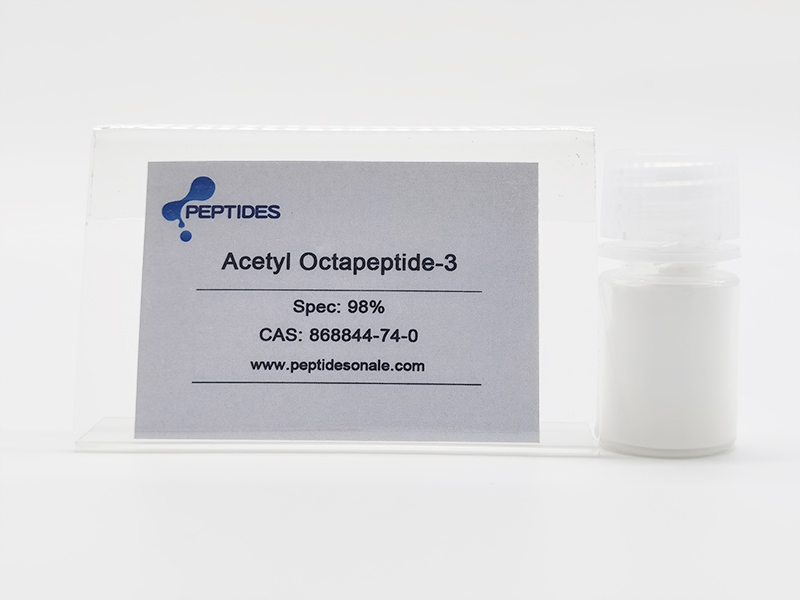
Acetyl Octapeptide-3 (SNAP-8) is a synthetic biomimetic peptide widely used in anti-aging skincare. It was developed as an enhanced version of Acetyl Hexapeptide-8 (Argireline) to reduce the appearance of expression lines by modulating neurotransmitter release. While it is valued as a non-invasive cosmetic ingredient, it also has limitations compared with clinical anti-wrinkle treatments such as botulinum toxin injections.
Pros of Acetyl Octapeptide-3
1. Reduces Dynamic Wrinkles
The primary benefit of Acetyl Octapeptide-3 is its ability to reduce the appearance of wrinkles caused by repeated facial expressions.
It is particularly effective for:
- Forehead lines
- Crow’s feet
- Frown lines
- Bunny lines
- Lip contour wrinkles
By reducing repetitive muscle contractions, it helps soften expression lines over time.
2. Non-Invasive Alternative to Injectable Treatments
Unlike botulinum toxin injections, Acetyl Octapeptide-3:
- Requires no needles
- Causes minimal discomfort
- Can be used at home
- Has virtually no recovery time
- Fits easily into a daily skincare routine
Although the results are more modest than injections, it offers a convenient option for people seeking a topical approach.
3. Good Safety Profile
Acetyl Octapeptide-3 is generally well tolerated in cosmetic formulations.
Advantages include:
- Low irritation potential
- Suitable for most skin types
- Compatible with long-term use
- Low risk of allergic reactions
- No known systemic toxicity when used topically as directed
Because it acts locally within the skin, systemic absorption is expected to be minimal.
4. Complements Other Anti-Aging Ingredients
Acetyl Octapeptide-3 targets muscle-related wrinkle formation, making it complementary to ingredients that improve skin structure.
It pairs well with:
- Retinoids
- Vitamin C
- Niacinamide
- Hyaluronic acid
- Ceramides
- Copper peptides
- Matrixyl peptides
- Growth factor-based ingredients
This allows formulators to address multiple mechanisms of skin aging in a single product.
5. Helps Delay Wrinkle Formation
In younger individuals or those with early signs of aging, regular use may help reduce repetitive skin folding associated with facial expressions.
This preventive role may contribute to delaying the development of deeper expression lines.
6. Excellent Cosmetic Compatibility
- Highly water-soluble
- Stable in many aqueous formulations
- Easy to incorporate into serums and creams
- Compatible with most common cosmetic ingredients
- Effective at relatively low concentrations
These characteristics make it a versatile ingredient for cosmetic formulators.
7. Improved Design Compared with Acetyl Hexapeptide-8
SNAP-8 was designed as an extended analog of Acetyl Hexapeptide-8.
Potential advantages include:
- Higher affinity for its molecular target
- Improved inhibition of neurotransmitter release in laboratory studies
- Greater wrinkle-reducing activity in some cosmetic evaluations
However, the extent of superiority in real-world use remains under investigation.
8. Suitable for Sensitive Skin
Unlike some anti-aging ingredients, Acetyl Octapeptide-3 generally does not cause:
- Peeling
- Dryness
- Photosensitivity
- Burning sensations
- Significant barrier disruption
This makes it suitable for users who cannot tolerate stronger active ingredients.
Cons of Acetyl Octapeptide-3
1. Less Effective Than Botulinum Toxin
The most significant limitation is its relatively modest efficacy.
Compared with injectable botulinum toxin, Acetyl Octapeptide-3:
- Produces subtler wrinkle reduction
- Does not paralyze muscles
- Primarily affects superficial skin layers
- Cannot achieve the same degree of wrinkle smoothing
2. Limited Skin Penetration
Acetyl Octapeptide-3 has a molecular weight of approximately 1,075 Da, which exceeds the commonly cited ~500 Da threshold for efficient passive skin penetration.
As a result:
- Only a small fraction penetrates intact skin.
- Advanced delivery systems (e.g., liposomes, nanoemulsions) may improve bioavailability but cannot fully overcome the barrier function of the skin.
3. Gradual Onset of Action
Visible improvements typically require:
- Daily application
- Several weeks of consistent use (often 4–8 weeks)
Users expecting immediate results may be disappointed.
4. Temporary Effects
The cosmetic benefits are not permanent.
Once treatment is discontinued:
- Muscle activity returns to normal.
- Expression lines gradually reappear.
- Continuous use is necessary to maintain benefits.
5. Limited Effect on Static Wrinkles
Acetyl Octapeptide-3 mainly targets wrinkles caused by muscle movement.
It has limited ability to improve:
- Deep static wrinkles
- Severe photoaging
- Skin laxity
- Significant collagen loss
- Advanced age-related structural changes
These concerns generally require ingredients that stimulate collagen production or professional dermatologic procedures.
6. Limited Independent Clinical Evidence
While laboratory studies and manufacturer-sponsored cosmetic evaluations support its mechanism and cosmetic benefits, large independent, randomized clinical trials are relatively scarce.
Most available evidence demonstrates improvements in wrinkle appearance rather than long-term structural changes in the skin.
7. Stability Challenges
Like many peptides, Acetyl Octapeptide-3 can degrade under unfavorable conditions.
Factors affecting stability include:
- High temperatures
- Strongly acidic or alkaline pH
- Oxidation (particularly of the methionine residue)
- Enzymatic degradation
Proper formulation and storage are important to preserve activity.
8. Higher Production Cost
Compared with many conventional cosmetic ingredients, peptide synthesis is more complex and expensive.
This contributes to:
- Higher raw material costs
- Increased formulation expenses
- Higher retail prices for peptide-containing skincare products
Ideal Candidates
Acetyl Octapeptide-3 is best suited for individuals who:
- Have mild to moderate expression lines.
- Prefer non-invasive skincare over injections.
- Are seeking preventive anti-aging care.
- Have sensitive skin that does not tolerate retinoids or acids well.
- Are willing to use the product consistently for gradual results.
Comparison of Cons and Pros
| Cons | Pros |
| Reduces expression lines | Less effective than botulinum toxin injections |
| Non-invasive and painless | Limited skin penetration |
| Generally well tolerated | Requires continuous use |
| Compatible with most skincare ingredients | Results develop gradually |
| Suitable for sensitive skin | Limited effect on deep static wrinkles |
| Easy to formulate into cosmetic products | Stability depends on proper formulation and storage |
| May help prevent new expression lines | Higher production cost than many standard cosmetic actives |
| Works synergistically with other anti-aging ingredients | Independent clinical evidence is still limited |
Overall Assessment
Acetyl Octapeptide-3 is a well-established cosmetic peptide for reducing the appearance of dynamic facial wrinkles. Its greatest strengths are its excellent safety profile, ease of topical application, compatibility with other skincare ingredients, and suitability for long-term use. It is particularly effective as part of a comprehensive anti-aging regimen aimed at preventing or softening early expression lines.
However, its effects are modest compared with injectable botulinum toxin, and it cannot replace medical aesthetic procedures for deep wrinkles or significant skin aging. Because of its limited skin penetration and temporary effects, it delivers the best results when used consistently in well-formulated products alongside ingredients that support collagen production, hydration, and skin barrier function.