

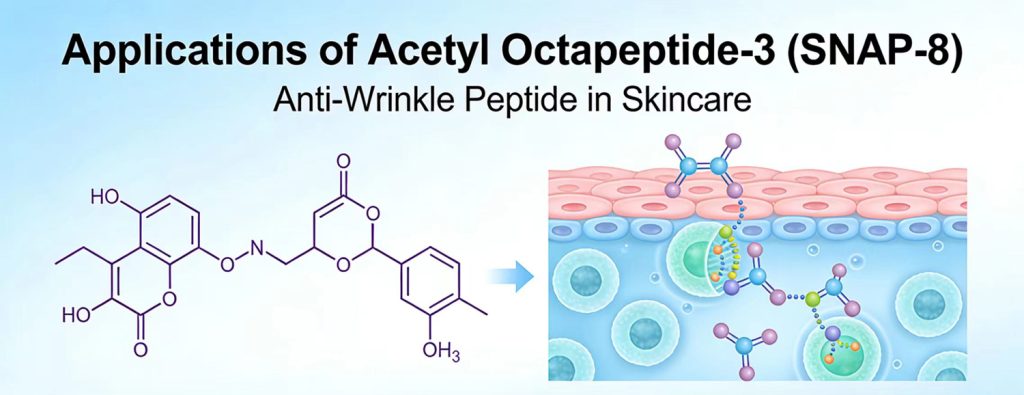
Acetyl Octapeptide-3 is primarily used in cosmetic and dermatological skincare formulations for its mild anti-wrinkle and muscle-relaxing properties. Its applications are centered on improving the appearance of expression lines rather than treating medical conditions.
Main applications
1. Anti-aging facial skincare
It is widely used in products aimed at reducing visible signs of aging, such as:
- Fine lines
- Crow’s feet
- Forehead wrinkles
- Nasolabial expression lines
Typically found in:
- Anti-aging serums
- Day and night creams
- “Botox-alternative” cosmetic products
2. Eye contour treatments
Because the eye area is prone to dynamic wrinkles, it is commonly formulated into:
- Eye creams
- Eye gels
- Lightweight peptide serums
Goal: soften repeated muscle-driven creasing around the eyes.
3. Preventive skincare (early anti-aging)
It is also used in products for younger users focusing on prevention:
- “First wrinkle” creams
- Lightweight daily moisturizers
- Maintenance skincare routines
The idea is to reduce the long-term formation of expression lines.
4. Combination peptide formulations
It is frequently blended with other cosmetic actives to enhance overall effect, such as:
- Hyaluronic acid (hydration + plumping)
- Niacinamide (barrier support + tone improvement)
- Other peptides (collagen-support or signal peptides like Matrixyl-type ingredients)
These combinations aim for a more noticeable anti-aging effect than using the peptide alone.
5. Professional cosmetic treatments (topical use only)
In spa or aesthetic settings, it may be included in:
- Post-treatment recovery serums
- Non-invasive “lifting” facial products
- High-end cosmeceutical masks
Practical formulation role
In product chemistry, Acetyl Octapeptide-3 is used as a:
- Signal-modulating peptide
- Anti-expression line active
- Smoothing agent in anti-aging systems
Key limitation in application
- Works only topically and mildly
- Requires consistent, long-term use
- Not a substitute for injectable neuromodulators like Botox
If you want, I can break down how it is formulated (pH stability, delivery systems, concentration ranges) or compare its real-world usage with other peptides like SNAP-8 or Matrixyl.