

5-Amino 1MQ (5-amino-1-methylquinolinium) is a small-molecule quaternary quinolinium compound (not a peptide) that functions as a selective inhibitor of the enzyme NNMT. Its structure is based on a methylated quinoline ring with an amino substitution.
1. Chemical Identity
- IUPAC name: 5-amino-1-methylquinolin-1-ium (commonly as iodide or chloride salt)
- Chemical class: Quinolinium (aromatic heterocyclic cation)
- CAS number: 42464-96-0 (commonly reported for salt forms)
- Molecular formula (free cation): C₁₀H₁₁N₂⁺
- Common salt form: iodide (C₁₀H₁₁N₂⁺·I⁻) or chloride
2. Structural Features
5-Amino 1MQ has three key structural components:
(1) Quinoline core
- Aromatic fused ring system (benzene + pyridine-like ring)
- Provides rigidity and lipophilicity for membrane permeability
(2) Quaternary nitrogen (N⁺-methyl group)
- Makes the molecule positively charged (cationic)
- Increases water solubility
- Plays a role in binding to NNMT active site
(3) 5-position amino group (-NH₂)
- Contributes to enzyme binding affinity
- Modulates selectivity toward NNMT
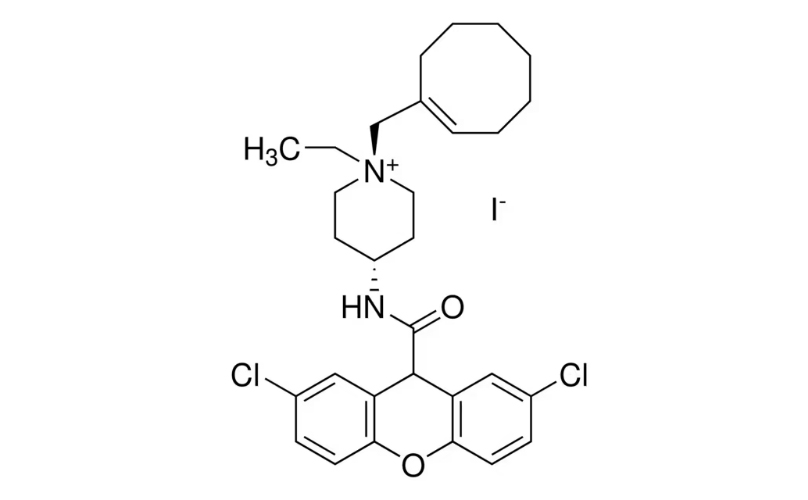
3. Structural Representation (text form)
A simplified structural description:
- Quinoline ring system
- N-methyl group at position 1 → quinolinium ion
- Amino group at position 5
- Paired with counterion (I⁻ or Cl⁻ in salt form)
4. Molecular Weight
Depending on form:
- Free cation: ~159.2 g/mol
- Iodide salt: ~286.1 g/mol
- Chloride salt: ~194–195 g/mol (varies slightly by source)
5. Physical Properties
(1)Appearance
- Typically a powder (off-white to yellow/orange tint)
- May appear crystalline depending on purification and salt form
(2)Solubility
- Highly water-soluble (due to charged quaternary nitrogen)
- Also soluble in polar solvents (e.g., DMSO)
- Limited solubility in non-polar solvents (oils, fats)
(3)Charge / Ionization
- Permanently positively charged (quaternary ammonium-like system)
- Exists as a cation paired with an anion (I⁻, Cl⁻)
(4)Stability
- Chemically stable small molecule
- More stable than peptides (no enzymatic breakdown risk)
- Stable at room temperature in dry form
(5)Lipophilicity
- Moderate (aromatic ring contributes lipophilicity, charge reduces it)
- Balanced for cell permeability + aqueous solubility
6. Functional Structure–Activity Relationship (SAR)
Its structure is tightly linked to its biological activity:
- Quinolinium core → binds NNMT active site region
- Positive charge → improves interaction with enzyme pocket
- Amino group → increases inhibitory selectivity
- Small size (~159 Da free base) → high membrane permeability
This combination is why it is effective as an NNMT inhibitor in research models.
7. Key Physical/Functional Summary
| Property | Description |
| Molecular type | Small molecule (not peptide) |
| Charge | Permanently cationic |
| Solubility | High in water |
| Stability | High (chemically robust) |
| Permeability | Good cellular entry |
| Primary interaction | NNMT enzyme binding |
Bottom Line
5-Amino 1MQ is a small, positively charged quinolinium derivative designed to interact with and inhibit NNMT. Its structure combines:
- A rigid aromatic quinoline core
- A permanent positive charge
- A reactive amino substitution
This makes it water-soluble, stable, and biologically active in metabolic enzyme pathways, which is why it is studied in obesity and NAD⁺ metabolism research.