

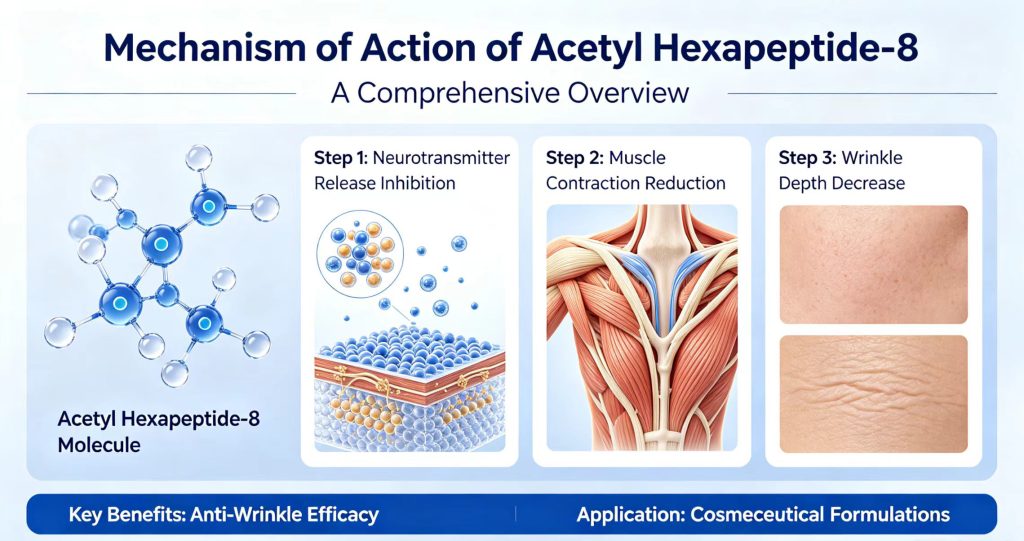
Acetyl Hexapeptide-8 acts through a neurotransmitter release–modulating mechanism that is inspired by (but far weaker than) the biological pathway targeted by botulinum toxin.
Its mechanism is best understood at the level of the SNARE complex, which controls acetylcholine release at nerve terminals.
1. Normal physiological mechanism (baseline)
To understand its action, start with normal muscle contraction signaling:
(1)A motor neuron sends an electrical signal
(2)This triggers vesicles containing acetylcholine (ACh)
(3)Vesicles must fuse with the neuron membrane via the SNARE complex
Key proteins: SNAP-25, syntaxin, VAMP
(4)Acetylcholine is released into the synaptic cleft
(5)Muscle fibers contract → facial expression lines form
2. Molecular target of Acetyl Hexapeptide-8
Acetyl Hexapeptide-8 is a synthetic fragment mimicking part of SNAP-25, one of the core SNARE proteins.
Key idea:
It behaves like a competitive mimic of SNAP-25.
- It resembles a short sequence of SNAP-25
- It can interact with SNARE assembly components
- It partially interferes with proper SNARE complex formation
3. Proposed mechanism of action
Step-by-step:
Step 1: Competitive interference
The peptide:
- Competes with endogenous SNAP-25 segments
- Inserts itself into SNARE assembly dynamics
Step 2: Destabilization of SNARE complex formation
This reduces the efficiency of:
- Vesicle docking
- Membrane fusion
Result:
- Less stable SNARE complex formation
Step 3: Reduced acetylcholine release (partial effect)
Because vesicle fusion is less efficient:
- Decreased acetylcholine exocytosis occurs locally
- Signal strength at neuromuscular junction is slightly reduced
Step 4: Reduced micro-muscle contraction
With less acetylcholine:
- Facial muscle micro-contractions weaken slightly
- Repetitive folding of skin is reduced
Step 5: Cosmetic outcome
Over time this leads to:
- Softer appearance of dynamic wrinkles
- Reduced expression line depth (mild)
- Smoother surface texture
4. Comparison with botulinum toxin (important context)
| Feature | Acetyl Hexapeptide-8 | Botulinum toxin |
| Mechanism | Competitive SNARE mimic | Proteolytic cleavage of SNARE proteins |
| Potency | Mild | Very strong |
| Permanence | Temporary, surface-level | Long-lasting neuromuscular blockade |
| Depth of action | Superficial/limited penetration | Direct neuronal action |
| Clinical effect | Subtle wrinkle softening | Strong muscle paralysis |
5. Biological limitations of the mechanism
Even though the mechanism is plausible in vitro, real-world limitations include:
(1)Skin penetration barrier
- Large, hydrophilic peptide (~889 Da)
- Poor diffusion into deeper neuromuscular junctions
(2)Dilution effect in skin layers
- Concentration decreases rapidly after topical application
(3)Short residence time
- Rapid degradation by skin enzymes unless stabilized
6. Scientific interpretation (important nuance)
The mechanism is best described as:
- A biomimetic modulation of SNARE-related signaling rather than true neuromuscular inhibition.
In practice:
- Strong mechanistic rationale exists
- Actual physiological effect in human skin is modest and formulation-dependent
7. Summary
Acetyl Hexapeptide-8 works by:
- Mimicking a fragment of SNAP-25
- Interfering with SNARE complex assembly
- Reducing vesicle fusion efficiency
- Slightly decreasing acetylcholine release
- Leading to mild reduction in facial micro-contractions