

Acetyl Tetrapeptide-11 is a synthetic cosmetic tetrapeptide, also known as Ac-Pro-Pro-Tyr-Leu, designed primarily for anti-aging, skin-firming, and epidermal-conditioning applications. Its best-characterized activity involves supporting keratinocyte growth, epidermal organization, and syndecan-1 production, rather than directly stimulating collagen synthesis like some other cosmetic peptides.
1. Main efficacy
| Efficacy | How it may work | Expected cosmetic benefit |
| Skin firming | Supports epidermal cohesion and organization | Firmer-feeling skin |
| Improves elasticity | Improves biomechanical properties of superficial epidermal layers | More supple skin |
| Anti-wrinkle/anti-aging | Helps maintain epidermal structure and cellular organization | Reduction in the appearance of fine lines |
| Epidermal repair support | Promotes keratinocyte activity and syndecan-1 synthesis | Better skin surface integrity |
| Skin smoothing | Improves superficial epidermal biomechanical properties | Smoother texture and skin relief |
| Skin conditioning | Maintains skin in good condition | Softer, healthier-feeling skin |
| Radiance improvement | Improved surface structure and texture | More even-looking, radiant skin |
The official cosmetic function is skin conditioning, while the scientific literature describes additional firming and anti-aging effects.
2. Epidermal cohesion and firmness
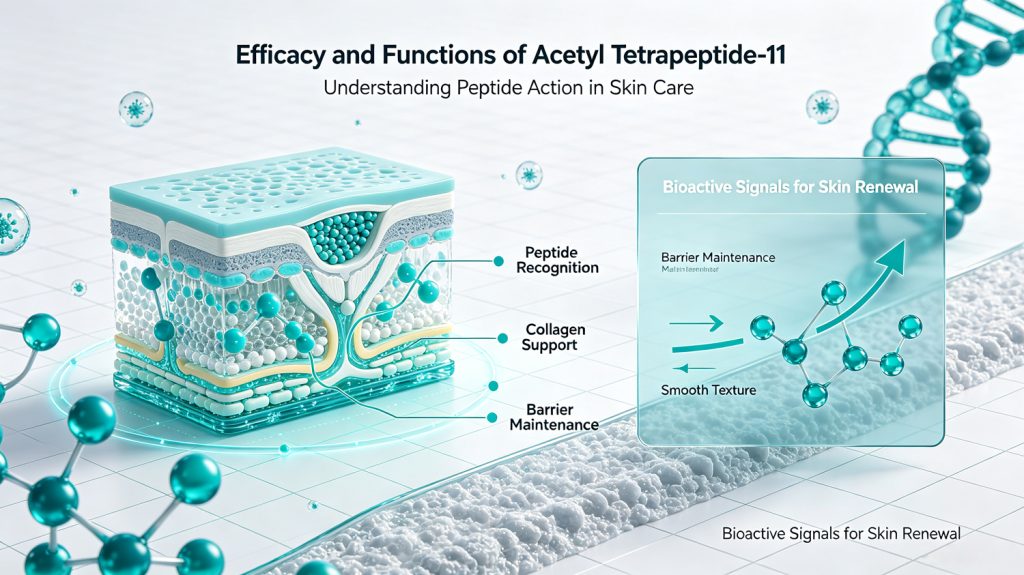
One of its most interesting properties is its effect on syndecan-1 (Sdc1).
Syndecan-1 is a cell-surface proteoglycan involved in cell adhesion, extracellular-matrix interactions, epidermal organization, and tissue homeostasis. In cultured human keratinocytes, Acetyl Tetrapeptide-11 increased syndecan-1 levels, supporting the idea that the peptide can improve the organization and cohesion of the epidermis.
This is important because healthy-looking skin depends not only on collagen in the dermis but also on the structural integrity of the epidermis.
3. Support for keratinocyte growth
Acetyl Tetrapeptide-11 has demonstrated stimulation of keratinocyte growth in vitro. Keratinocytes are the predominant cells of the epidermis and are responsible for maintaining and renewing the skin’s outer cellular layers.
Consequently, the peptide is generally positioned as an ingredient that supports:
- epidermal renewal
- epidermal organization
- surface integrity
- skin smoothness
- resilience of the superficial skin layers
This distinguishes it somewhat from collagen-focused peptides.
4. Improvement in skin firmness and elasticity
Clinical testing has provided some evidence for a visible/measurable benefit. In a controlled study involving 19 women aged 60–70, a cream containing Acetyl Tetrapeptide-11 was compared with placebo. After treatment, improvements were observed in biomechanical parameters of the superficial epidermal layers, with the active treatment producing approximately 5–10% greater effects than placebo in the reported measurements.
Therefore, its practical cosmetic role can be summarized as:
Acetyl Tetrapeptide-11 → improved epidermal organization/cohesion → improved superficial skin mechanics → firmer and smoother-looking skin.
5. Anti-aging function
Its anti-aging effect is primarily associated with maintaining skin architecture, rather than acting as a conventional exfoliant or wrinkle-relaxing peptide.
A review of topical peptides identifies Acetyl Tetrapeptide-11 as a signal peptide with anti-aging, anti-wrinkle, and firming applications, specifically associating it with keratinocyte growth and syndecan-1 synthesis.
It may therefore be particularly relevant to formulations targeting:
- loss of firmness
- age-related skin thinning
- fine lines
- rough texture
- reduced elasticity
- mature skin
6. Skin smoothing and texture
Clinical observations also reported improvements in skin texture, skin relief, and radiance after treatment with an Acetyl Tetrapeptide-11 formulation. These effects are consistent with improved superficial epidermal biomechanical properties and organization.
Thus, the peptide can contribute to a formulation’s:
texture improvement + smoothing + firmness + radiance profile.
7. Relationship to collagen
An important distinction is that Acetyl Tetrapeptide-11 should not be characterized primarily as a collagen-stimulating peptide.
Acetyl Tetrapeptide-9, for example, is associated with stimulation of type I collagen and lumican, whereas Acetyl Tetrapeptide-11 is more strongly associated with keratinocyte growth and syndecan-1.
This makes the two peptides potentially complementary in an anti-aging formulation:
Acetyl Tetrapeptide-9: more ECM/collagen-oriented
Acetyl Tetrapeptide-11: more epidermal organization/cohesion-oriented
8. Potential role in skin barrier support
Because syndecan-1 participates in epidermal organization and intercellular adhesion, increasing its expression may help support epidermal homeostasis and structural integrity.
However, it would be more accurate to describe this as barrier/structural support rather than claiming that Acetyl Tetrapeptide-11 is a direct substitute for established barrier-repair ingredients such as ceramides, cholesterol, or fatty acids.
9. Overall functional profile
The evidence supports viewing Acetyl Tetrapeptide-11 as an epidermis-focused anti-aging peptide:
↓
Keratinocyte activity + syndecan-1 synthesis
↓
Improved epidermal organization/cohesion
↓
Better superficial skin biomechanics
↓
Firmness + elasticity + smoothness + improved skin appearance
Its official cosmetic role remains skin conditioning, and the available clinical evidence is relatively small compared with that for some extensively studied cosmetic actives.
Bottom line
Acetyl Tetrapeptide-11 is best considered a skin-structuring and firming peptide rather than simply a collagen booster. Its principal reported activities are stimulating keratinocyte growth and syndecan-1 synthesis, which may improve epidermal cohesion and homeostasis. Clinical studies suggest improvements in firmness, elasticity, texture, skin relief, and overall anti-aging appearance, although the human evidence base is modest and formulation-dependent.