

Acetyl Tetrapeptide-2 and collagen are both associated with skin firmness and anti-aging, but they work very differently. Acetyl Tetrapeptide-2 is a small signaling peptide used as a cosmetic active, whereas collagen is a structural protein that forms an important part of the skin’s extracellular matrix.
| Feature | Acetyl Tetrapeptide-2 | Collagen |
| Type | Synthetic/modified tetrapeptide | Structural protein |
| Molecular size | Very small peptide | Very large protein |
| Main role | Cosmetic signaling/skin-conditioning active | Structural support and hydration |
| Primary target | Cellular/extracellular signaling pathways related to skin aging | Dermal extracellular matrix |
| Firmness | May support firmness and elasticity indirectly | Provides the structural framework for firmness |
| Wrinkles | May help improve the appearance of fine lines over time | Topical collagen mainly provides moisturizing/film-forming benefits |
| Skin hydration | Indirect/moderate | Good topical moisturizing and film-forming effect, depending on form |
| Penetration | Small size can be advantageous, although formulation matters | Intact collagen has very limited penetration through the stratum corneum |
| Collagen synthesis | Intended to support pathways associated with youthful skin appearance | Supplies collagen itself, but topical collagen generally does not simply replace dermal collagen |
| Typical cosmetic use | Anti-aging serums, creams, eye products | Moisturizers, masks, creams, hydrolyzed-collagen formulations |
| Best suited for | Firmness, elasticity, anti-aging formulations | Hydration, conditioning, film formation and skin feel |
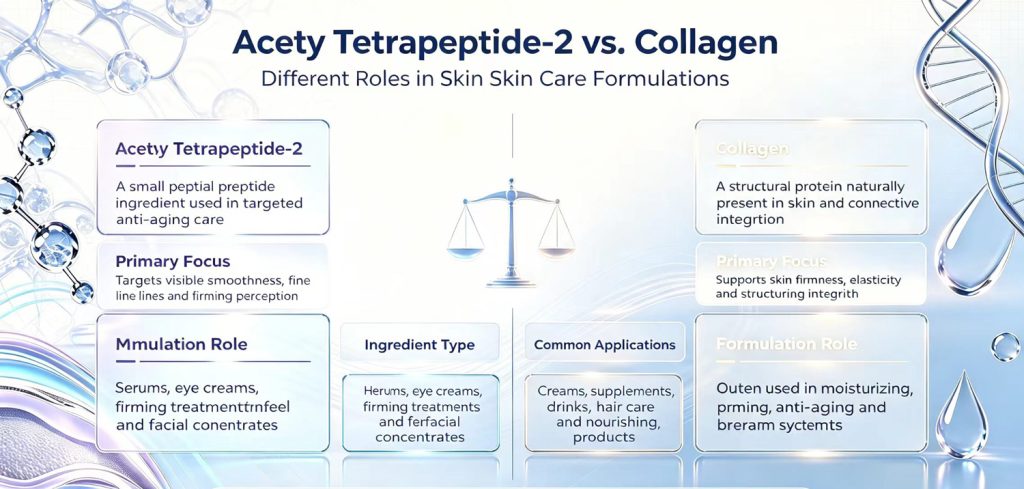
1. How they differ mechanistically
Acetyl Tetrapeptide-2 is designed to function as a signaling-type cosmetic peptide. Rather than acting as a bulk structural protein, it is used at relatively low concentrations to influence biological processes associated with skin aging and extracellular-matrix maintenance.
Collagen, by contrast, is one of the major proteins naturally present in the dermis. It contributes to the skin’s tensile strength and structural integrity. As skin ages, collagen production and organization change, contributing to wrinkles and loss of firmness.
An important distinction is that putting collagen on the skin is not equivalent to rebuilding dermal collagen. Large collagen molecules generally remain near the skin surface, where they can form a moisturizing/conditioning film. Hydrolyzed collagen has smaller fragments and can improve skin feel and hydration, but it still should not be considered a direct replacement for the collagen naturally present in the dermis.
2. Which is better for anti-aging?
For a modern anti-aging cosmetic formulation, Acetyl Tetrapeptide-2 can be more interesting when the objective is to use a bioactive peptide rather than simply a moisturizing protein.
Collagen is particularly useful when the formulation needs:
- Surface hydration
- Film-forming properties
- Improved skin softness
- Conditioning
- A temporary smoothing effect
Acetyl Tetrapeptide-2 is more relevant when the formulation is designed around:
- Skin firmness
- Elasticity
- Reduction in the appearance of age-related changes
- Peptide-based anti-aging strategies
- Supporting a more youthful appearance
3. Does Acetyl Tetrapeptide-2 replace collagen?
No.
It should not be viewed as a substitute for the collagen already present in the skin. Its proposed cosmetic function is closer to modulating biological signaling associated with skin structure and aging, while collagen is a major structural component itself.
A useful way to think about it is:
Collagen = structural material
Acetyl Tetrapeptide-2 = signaling/biological-support ingredient
4. Can they be used together?
Yes. In fact, they can be complementary in a cosmetic formula.
A formulation could combine:
Acetyl Tetrapeptide-2 + hydrolyzed collagen + humectants + barrier-support ingredients
This provides different functions:
- Acetyl Tetrapeptide-2: peptide-based anti-aging support
- Hydrolyzed collagen: hydration, film formation and conditioning
- Glycerin/hyaluronic acid: water-binding hydration
- Ceramides: barrier support
- Antioxidants: protection against oxidative stress
Bottom line
If the goal is surface hydration and conditioning, collagen—particularly hydrolyzed collagen—can be useful.
If the goal is a peptide-centered anti-aging formulation focused on firmness and skin appearance, Acetyl Tetrapeptide-2 is generally the more targeted ingredient.
However, neither topical Acetyl Tetrapeptide-2 nor topical collagen should be interpreted as simply “replacing lost collagen.” Their cosmetic functions and mechanisms are fundamentally different.