

Acetyl Tetrapeptide-11 (Ac-PPYL; Syniorage) is a synthetic signaling tetrapeptide composed of acetylated Pro-Pro-Tyr-Leu. Its main cosmetic mechanism is associated with epidermal renewal, syndecan-1 regulation, and improvement of dermal–epidermal junction (DEJ) integrity, rather than directly acting as a conventional collagen-stimulating peptide.
1. Stimulates keratinocyte activity
The best-established early finding is that Acetyl Tetrapeptide-11 can stimulate keratinocyte growth/activity.
In vitro studies reported increased keratinocyte proliferation/growth following exposure to the peptide. This is important because keratinocytes are responsible for maintaining much of the epidermal structure and barrier.
Simplified pathway:
Acetyl Tetrapeptide-11 → keratinocyte signaling → increased keratinocyte activity → improved epidermal renewal
2. Increases syndecan-1
A key molecular target associated with Acetyl Tetrapeptide-11 is syndecan-1 (CD138), a cell-surface heparan-sulfate proteoglycan.
Studies have found that Acetyl Tetrapeptide-11 stimulates syndecan-1 synthesis/expression in keratinocytes.
Syndecan-1 participates in:
- cell–cell and cell–matrix adhesion
- epidermal organization
- growth-factor signaling
- extracellular-matrix interactions
- tissue repair and remodeling
Consequently, increasing syndecan-1 may help reinforce the structural communication between epidermal cells and the underlying extracellular matrix.
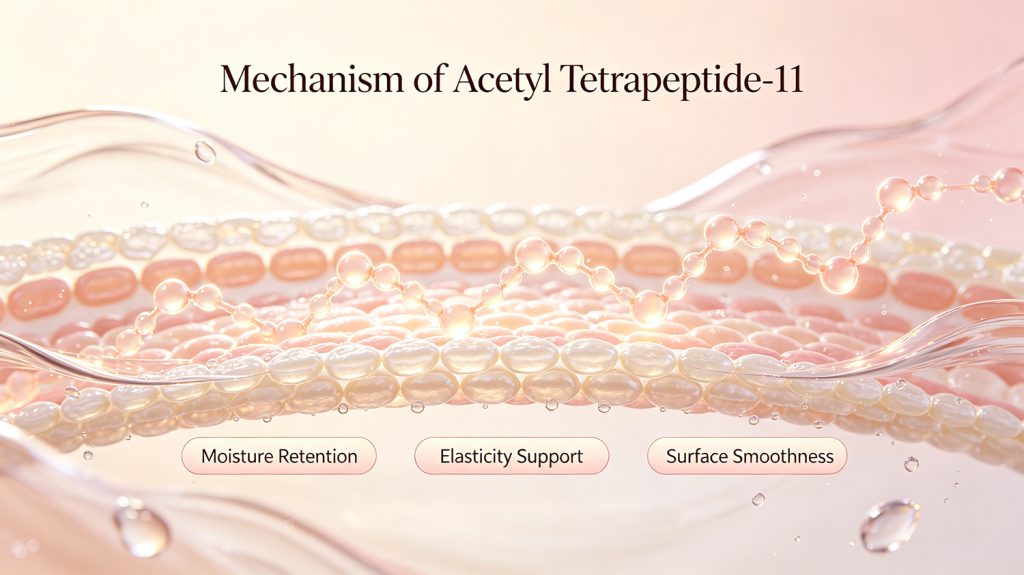
3. Supports the dermal–epidermal junction
The DEJ is the interface between the epidermis and dermis. It provides mechanical attachment while allowing communication between these two layers.
Syndecan-1 is an important membrane-associated component involved in this architecture. Acetyl Tetrapeptide-11 is therefore positioned as a DEJ-supporting peptide rather than simply a surface moisturizer.
A simplified model is:
↓
↑ syndecan-1
↓
better cell–matrix interactions and epidermal organization
↓
stronger DEJ structural integrity
↓
improved firmness and elasticity
4. May influence collagen/DEJ-associated proteins
More recent experimental literature reports that Acetyl Tetrapeptide-11 is associated with changes in COL17A1 (collagen XVII) and DDR1 in keratinocyte/full-thickness skin models. A 2025 review summarizes reported findings as increased syndecan-1 and COL17A1 together with decreased DDR1.
This is potentially important because collagen XVII is a major component of epidermal–basement-membrane adhesion structures.
Thus, the mechanism can be viewed more broadly as:
Syndecan-1 regulation + DEJ protein regulation → improved epidermal–dermal cohesion
However, these molecular findings are primarily in vitro/ex vivo evidence, so they should not be interpreted as proof that topical Acetyl Tetrapeptide-11 directly increases collagen XVII in human skin to the same extent.
5. Improves epidermal cohesion and biomechanical properties
The downstream consequence of these effects is improved organization and cohesion of the superficial epidermis.
In a formulation study, a cream containing a 3% active ingredient based on Acetyl Tetrapeptide-11 produced significantly improved firmness and elasticity of the superficial epidermal layers after 56 days, with effects reported as approximately 5–10% greater than placebo.
This provides a plausible link between the molecular mechanism and visible cosmetic effects:
↑ keratinocyte activity
+
↑ syndecan-1
+
improved epidermal/DEJ organization
→ better epidermal cohesion
→ greater firmness and elasticity
→ smoother-looking skin
6. Possible interaction with growth-factor signaling
Syndecan-1 is not merely an adhesion molecule. It can function as a co-receptor for signaling molecules and growth factors, including interactions involving fibroblast growth factor and hepatocyte growth factor pathways. This means that altering syndecan-1 levels could influence cellular communication within the skin microenvironment.
This provides a potential explanation for why a very small peptide can produce broader structural effects than would be expected from simple moisturization.
The important distinction is that Acetyl Tetrapeptide-11 does not appear to function like a growth factor itself; rather, its proposed action involves modulation of skin-cell signaling and structural proteins.
7. Possible anti-aging mechanism
The overall anti-aging mechanism can therefore be summarized as:
↓
cellular signaling in keratinocytes
↓
↑ keratinocyte growth/activity
↓
↑ syndecan-1
↓
improved cell–matrix adhesion and DEJ organization
↓
support for collagen XVII/DEJ-associated structures
↓
improved epidermal cohesion
↓
better firmness, elasticity and skin texture
This mechanism differs from Acetyl Tetrapeptide-9, which is primarily associated with stimulation of collagen I and lumican.

Important limitation
The evidence for Acetyl Tetrapeptide-11 is strongest for cell culture, skin models and cosmetic efficacy studies, rather than large independent human clinical trials. A recent review likewise categorizes the mechanistic evidence for Acetyl Tetrapeptide-11 largely as in vitro evidence.
So, scientifically, it is more accurate to describe Acetyl Tetrapeptide-11 as a DEJ/epidermal-architecture signaling peptide that supports skin firmness and cohesion, rather than claiming that it directly rebuilds collagen throughout the dermis.
In one sentence: Acetyl Tetrapeptide-11 appears to work mainly by modulating keratinocyte signaling and increasing syndecan-1, thereby supporting epidermal cohesion and dermal–epidermal junction organization, with downstream improvements in firmness and elasticity.