

Acetyl Tetrapeptide-11 is a synthetic cosmetic peptide used primarily as a skin-conditioning and anti-aging active. It is designed to support epidermal structure and skin firmness by influencing proteins involved in cell adhesion and epidermal cohesion.
1. Basic introduction
- INCI name: Acetyl Tetrapeptide-11
- Peptide sequence: Ac-Pro-Pro-Tyr-Leu-OH (Ac-PPYL)
- CAS No.: 928006-88-6
- Chemical class: Acetylated tetrapeptide
- Origin: Synthetic
- Primary cosmetic function: Skin conditioning
- Typical positioning: Firming, anti-aging, skin-structure and mature-skin care
Structurally, it consists of four amino-acid residues—proline, proline, tyrosine, and leucine—with an acetyl group attached at the N-terminus. Regulatory databases identify it as 1-acetyl-L-prolyl-L-prolyl-L-tyrosyl-L-leucine.
2. Origin
Acetyl Tetrapeptide-11 is synthetically produced rather than extracted directly from plants or animals. COSMILE Europe classifies its origin as synthetic, while Korean and Japanese cosmetic ingredient databases describe it as the reaction product obtained by acetylating Tetrapeptide-11.
The underlying tetrapeptide is composed of amino acids found naturally in proteins, but this does not mean the cosmetic ingredient itself is naturally sourced. Its defined commercial ingredient is manufactured through peptide synthesis followed by N-terminal acetylation.
3. Chemical and physical properties
The authoritative FDA substance record identifies Acetyl Tetrapeptide-11 as a peptide/protein substance and gives the sequence as P-Pro-Tyr-Leu with N-terminal acetyl modification.
A laboratory chemical supplier reports the following characteristics:
| Property | Information |
| Chemical name | 1-Acetyl-L-prolyl-L-prolyl-L-tyrosyl-L-leucine |
| Short sequence | Ac-PPYL-OH |
| CAS | 928006-88-6 |
| Molecular formula | C₂₇H₃₈N₄O₇ |
| Molecular weight | ~530.6 g/mol |
| Physical form | Solid |
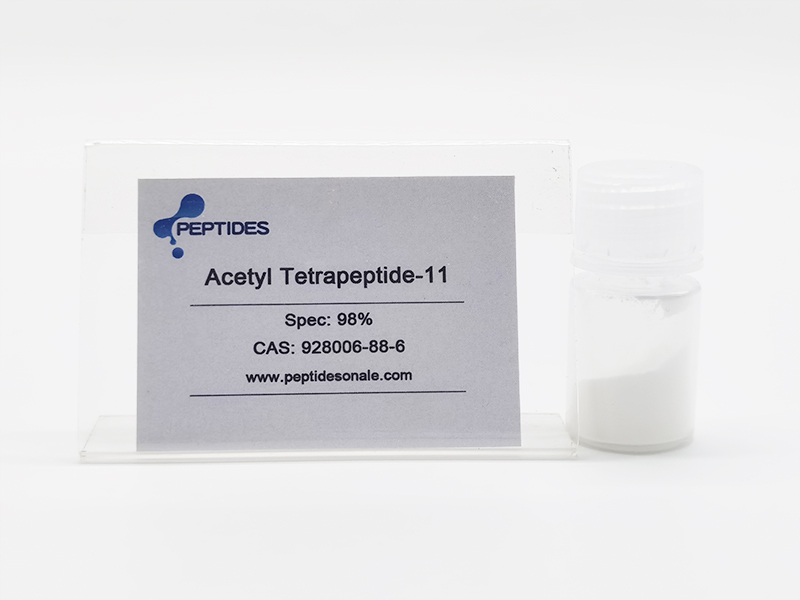
| Appearance in commercial raw materials | Typically white powder |
| DMSO solubility | ≥10 mg/mL reported |
| Ethanol solubility | ≥10 mg/mL reported |
| PBS pH 7.2 | Sparingly soluble, approximately 1–10 mg/mL reported |
The formula and molecular weight are supported by Cayman Chemical; commercial appearance can vary according to supplier and formulation grade.
4. Why the peptide is interesting for skincare
Acetyl Tetrapeptide-11 is particularly associated with epidermal cohesion and firmness rather than simply being a generic collagen peptide.
Research cited for the ingredient indicates activity involving:
- Syndecan-1 (SDC1) — a proteoglycan important for epidermal organization and cell interactions.
- Collagen XVII (COL17A1) — an important component associated with adhesion between basal keratinocytes and the basement-membrane region.
- DDR1 — a collagen-responsive receptor whose expression has been reported to decrease in experimental models following treatment.
In human keratinocyte experiments, Acetyl Tetrapeptide-11 was reported to increase syndecan-1 and collagen XVII levels. These findings provide a mechanistic rationale for its use in products aimed at improving the appearance of firmness, elasticity, and skin texture.
5. Cosmetic role
Its officially recognized cosmetic function is skin conditioning—helping maintain skin in good condition.
In commercial skincare, it is therefore commonly positioned as a:
- Firming peptide
- Anti-aging peptide
- Skin-conditioning active
- Mature-skin care ingredient
- Ingredient for improving the appearance of skin texture and elasticity
It has appeared in serums, creams, essences, eye products, and other leave-on anti-aging formulations.

6. Development background
Acetyl Tetrapeptide-11 has been associated with the development of targeted cosmetic peptides intended to counter age-related changes in the epidermis. Earlier ingredient literature describes it under commercial names such as SYN®-IORAGE / SYN®-IORAGE-type materials, with the peptide developed to target epidermal cohesion and age-related structural changes.
A 2008 publication, Counteracting ageing phenomena by new pure tetrapeptides with targeted efficacy, is cited as an early scientific reference for the ingredient’s activity.
7. Overall assessment
Acetyl Tetrapeptide-11 can be summarized as a synthetic, acetylated tetrapeptide designed for targeted cosmetic skin conditioning. Its distinctive feature is its proposed action on epidermal structural and adhesion-related proteins, especially syndecan-1 and collagen XVII, rather than simply serving as a source of amino acids.
Importantly, much of the mechanistic evidence is in vitro or ex vivo, so the molecular findings should not automatically be interpreted as proof of dramatic clinical anti-aging effects in every finished product. Formulation, concentration, delivery system, and overall product design can substantially affect real-world performance.
In short: Acetyl Tetrapeptide-11 is a synthetic Ac-PPYL peptide used in modern anti-aging skincare, particularly for supporting the appearance of firmer, more cohesive, elastic, and better-conditioned skin.