

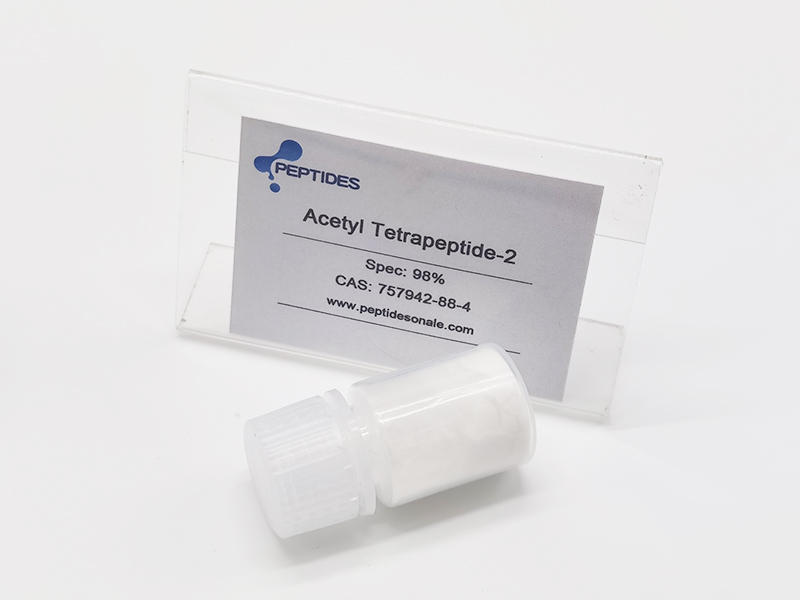
Acetyl Tetrapeptide-2 is a synthetic, short-chain cosmetic peptide used primarily in anti-aging and skin-conditioning formulations. It belongs to the tetrapeptide family and is designed to support the skin’s appearance, particularly firmness, elasticity, smoothness, and signs of aging.
1. Basic profile
| Property | Information |
| INCI name | Acetyl Tetrapeptide-2 |
| Category | Cosmetic peptide / signal peptide |
| Peptide length | Tetrapeptide (4 amino-acid residues) |
| Type | Synthetic, acetylated peptide |
| Primary field | Skin care and anti-aging cosmetics |
| Main cosmetic role | Skin conditioning and anti-aging support |
| Typical formulations | Serums, creams, lotions, eye-care products |
| Target concerns | Loss of firmness, elasticity, fine lines, mature-looking skin |
2. What does the name mean?
The name describes its chemical nature:
- “Tetrapeptide” means the molecule contains four amino-acid residues.
- “Acetyl” indicates that an acetyl group has been introduced into the peptide structure.
- The acetyl modification can alter properties such as stability, solubility, lipophilicity, and interaction with biological targets compared with the corresponding unmodified peptide.
The exact amino-acid sequence and molecular specifications should be confirmed from the supplier’s technical documentation, because commercial cosmetic peptide preparations can differ in their presentation and accompanying ingredients.
3. How does it work cosmetically?
Acetyl Tetrapeptide-2 is generally classified as a skin-conditioning/anti-aging peptide. Cosmetic peptide ingredients are typically designed to interact with biological processes involved in maintaining the extracellular matrix and skin structure.
Its proposed cosmetic effects include:
- Supporting the appearance of skin firmness
- Helping improve the appearance of elasticity
- Smoothing the appearance of fine lines and wrinkles
- Supporting a more toned and youthful-looking complexion
- Improving overall skin conditioning
It is important to distinguish these cosmetic claims from pharmaceutical effects: evidence for individual cosmetic peptides is often based on supplier-sponsored in-vitro and/or small clinical studies, and results can depend strongly on formulation and concentration.
4. Where is it used?
Acetyl Tetrapeptide-2 may be incorporated into:
- Anti-aging serums
- Facial creams
- Firming treatments
- Eye creams
- Neck and décolleté products
- Moisturizing formulations
- Mature-skin products
- Professional cosmetic formulations
5. Advantages as a cosmetic active
Some of the reasons formulators use peptide ingredients such as Acetyl Tetrapeptide-2 include:
Targeted activity: Peptides can be designed to influence specific biological pathways rather than functioning only as conventional moisturizers.
Low use level: Cosmetic peptides are generally used at relatively low concentrations compared with bulk formulation ingredients.
Compatibility with anti-aging systems: It can potentially be combined with ingredients such as hyaluronic acid, ceramides, antioxidants, and other cosmetic peptides.
Multi-dimensional anti-aging positioning: It can complement ingredients that primarily provide hydration, antioxidant protection, exfoliation, or barrier support.
6. Acetyl Tetrapeptide-2 vs. collagen
They are fundamentally different.
- Collagen is a large structural protein.
- Acetyl Tetrapeptide-2 is a very small synthetic peptide.
- Topically applied collagen primarily functions as a film-forming/moisturizing ingredient because intact collagen has limited penetration into deeper skin.
- A cosmetic peptide is instead intended to provide biological signaling or conditioning effects.
Therefore, Acetyl Tetrapeptide-2 should not be regarded as simply a small form of collagen.

7. Important formulation considerations
Because peptides can be sensitive to formulation conditions, formulators should pay attention to:
- pH
- Temperature during processing
- Oxidizing/reducing conditions
- Preservative system
- Compatibility with surfactants and other actives
- Storage conditions
- Peptide concentration and purity
The supplier’s recommended pH range, dosage, solvent system, processing temperature, and storage conditions should take precedence over generic recommendations.
Bottom line
Acetyl Tetrapeptide-2 is a synthetic acetylated tetrapeptide used as a cosmetic anti-aging and skin-conditioning active. Its main purpose is to support the appearance of firmness, elasticity, smoothness, and youthful-looking skin, rather than acting as a structural replacement for collagen. Its actual efficacy depends on the peptide preparation, concentration, formulation, and quality of supporting clinical evidence.