

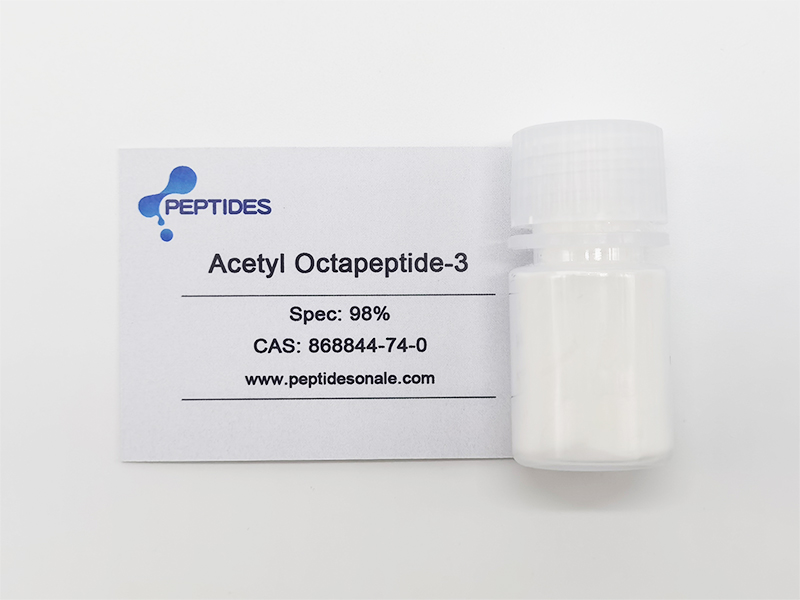
Acetyl Octapeptide-3, commonly known as SNAP-8, is a synthetic cosmetic peptide developed for use in anti-aging skincare formulations. It is designed to reduce the appearance of expression lines and dynamic wrinkles caused by repeated facial muscle movements.
It belongs to a class of neuromodulating cosmetic peptides, which aim to mimic, in a very mild and topical way, the wrinkle-reducing effects of botulinum toxin (Botox)—without injections or nerve paralysis.
Acetyl Octapeptide-3 is widely used in cosmeceutical products, especially serums and eye creams, but it is not a drug and has no systemic medical approval.
1. Origin and Development
- Developer: Lipotec S.A.U. (Spain), later acquired by Lubrizol
- Time period: Early 2000s
- Design goal: Improve upon Argireline (Acetyl Hexapeptide-8)
- Strategy: Extend peptide chain from 6 to 8 amino acids to enhance SNARE-binding affinity
Scientific inspiration
The peptide was designed based on the SNARE complex biology, particularly:
- SNAP-25 protein, which regulates neurotransmitter release
- Mechanism similar in concept (not potency) to botulinum toxin, which blocks this pathway
Acetyl Octapeptide-3 is essentially an elongated analog of Argireline intended to strengthen interaction with SNARE-related protein interfaces.
2. Chemical Identity and Structure
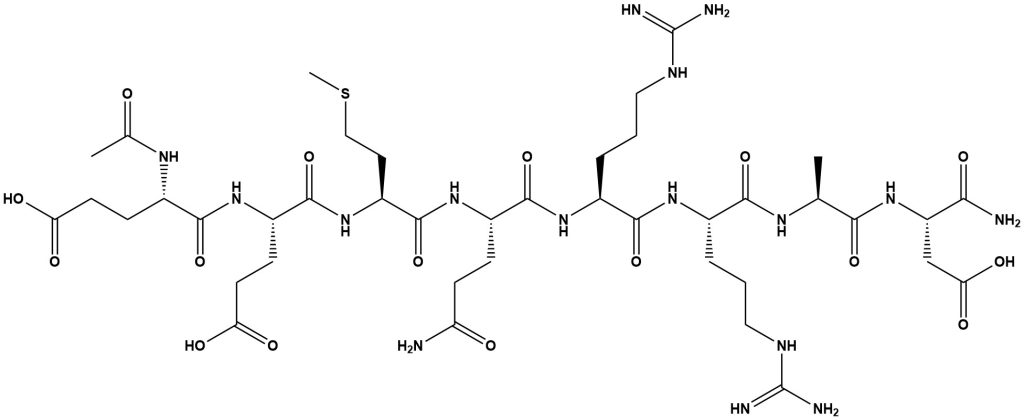
- INCI name: Acetyl Glutamyl Heptapeptide-1 (historical: Acetyl Octapeptide-3)
- Sequence: Ac-EEMQRRAD-NH₂
- Molecular weight: ~1075 Da
- Type: Synthetic octapeptide (8 amino acids)
- Modification: N-terminal acetylation
Key structural features
- Rich in glutamic acid and arginine residues
- Designed to mimic the N-terminal region of SNAP-25
- Hydrophilic and highly water-compatible
3. Physical and Chemical Properties
| Property | Description |
| Physical form | White to off-white powder |
| Solubility | Water-soluble |
| Stability | Moderate (sensitive to heat, oxidation, extreme pH) |
| Storage | Cool, dry, light-protected conditions |
| Formulation compatibility | Serums, gels, emulsions |
4. Mechanism of Action (Cosmetic Level)
Core biological target: SNARE complex
The SNARE complex controls vesicle fusion and neurotransmitter release in neurons. In facial muscles, this pathway contributes to repeated contractions that form expression lines.
Proposed mechanism of Acetyl Octapeptide-3(SNAP-8):
- Mimics a segment of SNAP-25 protein
- Competes for binding in SNARE complex assembly
- Weakens vesicle fusion efficiency
- Reduces acetylcholine release signal strength
- Leads to mild reduction in facial micro-contractions
Important clarification
- Effect is surface-level and indirect
- Does not penetrate deeply like Botox
- Does not chemically cleave proteins
Evidence suggests this mechanism is partially theoretical and supported mainly by cosmetic industry studies, with limited independent clinical validation.
5. Biological and Functional Properties
A. Neuromodulating cosmetic activity
Mild reduction in expression-related muscle movement signals
Targets dynamic wrinkles (not structural wrinkles)
B. Anti-wrinkle effect
Softens appearance of:
- Crow’s feet
- Forehead lines
- Glabellar lines
C. Skin-smoothing effect
Creates a more relaxed skin appearance
Works best in early-stage wrinkles
6. Applications in Cosmetics
(1) Anti-aging serums
- Primary delivery system
- Often combined with hyaluronic acid or niacinamide
(2) Eye creams
- Targets thin skin and expression lines around eyes
(3) Multi-peptide complexes
Frequently combined with:
- Argireline (Acetyl Hexapeptide-8)
- Matrixyl peptides
- GHK-Cu (copper peptide)
(4) “Botox-alternative” cosmetic products
- Marketed for non-invasive wrinkle reduction
- Positioned for users avoiding injections
7. Efficacy and Scientific Evidence
What studies suggest:
Manufacturer studies report modest reduction in wrinkle depth
Some cosmetic formulations show improvement in skin smoothness over 4–12 weeks
Limitations of evidence:
Mostly in vitro or supplier-sponsored studies
Limited independent large-scale clinical trials
Skin penetration remains a major scientific question due to:
- High molecular weight (~1075 Da)
- Barrier function of stratum corneum
Some reviews highlight that real-world effects may be partly due to hydration and formulation effects, not deep neuromuscular inhibition.
8. Safety Profile
- Generally regarded as safe for topical cosmetic use
- Low irritation potential
- Non-toxic at cosmetic concentrations
- Not approved as a pharmaceutical drug
Side effects (rare):
- Mild redness
- Skin sensitivity (vehicle-dependent)

9. Limitations
Effects are subtle, not dramatic
Requires consistent long-term use
Does not replace:
- Botox (botulinum toxin)
- Retinoids (collagen remodeling agents)
Penetration to neuromuscular junction is scientifically uncertain
10. Summary
Acetyl Octapeptide-3 (SNAP-8) is a synthetic, acetylated octapeptide designed to mimic part of the SNAP-25 protein and modulate the SNARE complex involved in neurotransmitter release. It is used in cosmetics to reduce the appearance of expression wrinkles through mild neuromuscular signaling inhibition.
While it is popular in anti-aging skincare, its effects are modest, topical, and not equivalent to medical neuromodulators like Botox.