

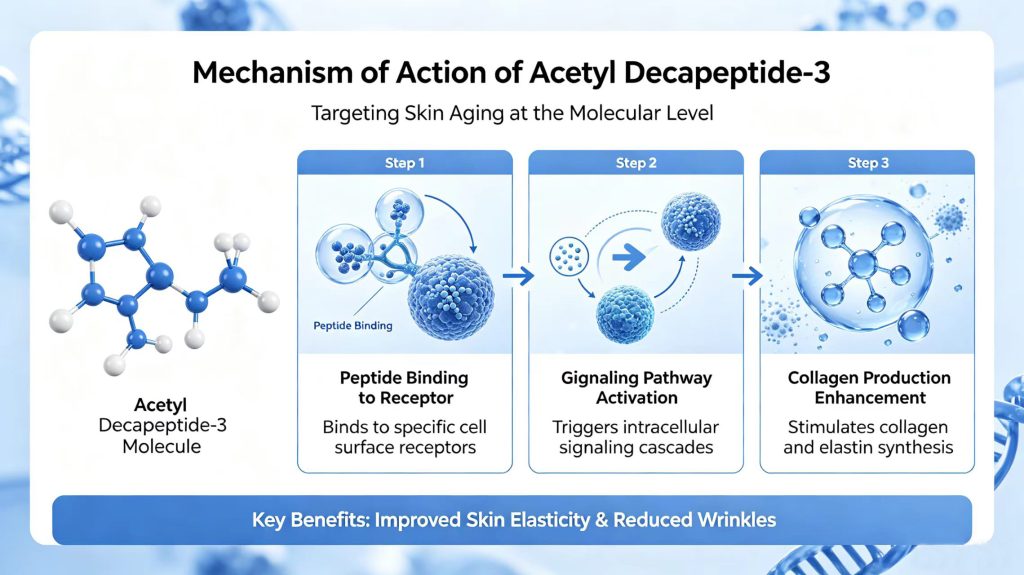
Acetyl Decapeptide-3 is a cosmetic signal peptide, meaning its mechanism is based on cell signaling modulation rather than pharmacological receptor binding like a drug. Its exact receptor target is not fully characterized, but its functional mechanism can be understood through how similar matrix-regulating decapeptides behave in skin biology.
1. Primary Mechanism: Fibroblast signaling activation
The central proposed mechanism is activation of dermal fibroblasts, the cells responsible for maintaining skin structure.
What happens:
Peptide interacts with skin surface or extracellular matrix signaling systems
Fibroblasts increase activity related to:
- Collagen synthesis (type I & III)
- Elastin production (indirectly)
- Glycosaminoglycans (e.g., hyaluronic acid components)
Outcome:
- Improved dermal density
- Increased skin firmness
- Reduced fine-line visibility
2. Extracellular Matrix (ECM) modulation
Acetyl Decapeptide-3 is thought to act as an ECM “repair signal mimic”.
Mechanistic steps:
Mimics fragments of naturally occurring ECM breakdown peptides
Skin interprets this as “damage or aging signal”
Triggers controlled repair response:
- Increased matrix protein synthesis
- Balanced ECM turnover (collagen formation vs. degradation)
Outcome:
- Smoother skin texture
- Improved structural integrity over time
3. Wound-healing–like signaling cascade
Although not a wound-healing drug, it may activate repair-associated pathways:
Proposed pathways involved (indirect evidence):
- TGF-β–related signaling (collagen regulation axis)
- Fibroblast-keratinocyte communication loops
- Mild upregulation of repair cytokines
Functional interpretation:
- Skin behaves as if undergoing micro-repair
- Leads to gradual remodeling of dermal structure
4. Anti-aging “stress signaling” model
A key theory behind this peptide class is the stress-mimetic hypothesis:
Concept:
- Small peptides mimic signals released from degraded collagen/ECM
- These fragments act as “danger signals” to skin cells
Resulting response:
- Cells increase production of structural proteins
- Skin shifts into a maintenance/repair phenotype
5. Indirect anti-inflammatory modulation
Some cosmetic data suggests mild modulation of inflammatory tone:
Possible effects:
- Reduced low-grade inflammatory signaling (e.g., oxidative stress pathways)
- Improved skin resilience under UV or pollution stress
Outcome:
- Less chronic micro-inflammation (“inflammaging” contribution reduced)
6. Structural basis of mechanism
The peptide’s structure explains its behavior:
N-acetylation
- Improves stability in skin environment
- Reduces rapid enzymatic breakdown
Small size (~10 amino acids)
- Allows signaling activity but limits deep penetration
Hydrophilicity
- Keeps activity mostly in epidermal/upper dermal layers
7. Delivery-dependent activity (critical point)
The mechanism only becomes meaningful if the peptide reaches viable skin layers.
Without delivery systems:
- Mostly remains in stratum corneum
- Minimal biological signaling
With delivery systems (liposomes, nanoemulsions):
- Greater dermal penetration
- More fibroblast interaction
- Stronger ECM response
8. Net biological outcome
When active in skin, the overall mechanism results in:
- ↑ Collagen synthesis signaling
- ↑ Dermal matrix remodeling
- ↑ Skin elasticity over time
- ↓ Fine-line appearance
- ↑ Skin texture smoothness
Key limitation (important)
There is no fully mapped receptor-level mechanism for Acetyl Decapeptide-3 in peer-reviewed literature. Most mechanistic understanding is based on:
- Cosmetic peptide analog research
- Fibroblast assay data
- ECM remodeling behavior of similar signal peptides
Bottom line
Acetyl Decapeptide-3 works primarily as a fibroblast-activating ECM signal peptide, triggering a mild “repair mode” in skin that promotes collagen production, matrix remodeling, and gradual anti-aging effects—especially when properly formulated for skin delivery.