

Acetyl Tetrapeptide-5 is a synthetic cosmetic tetrapeptide commonly used in eye-area and anti-aging formulations. It is particularly associated with improving the appearance of under-eye puffiness, dark circles, and signs of fatigue, while also supporting smoother-looking skin.
1. Main efficacy
| Function | Potential cosmetic effect | Mechanistic rationale |
| Reduces the appearance of under-eye puffiness | Eyes look less swollen or tired | May influence fluid balance and the appearance of edema around the eye |
| Helps improve dark-circle appearance | Under-eye area can appear brighter and more even | May reduce factors associated with fluid accumulation and skin optical irregularities |
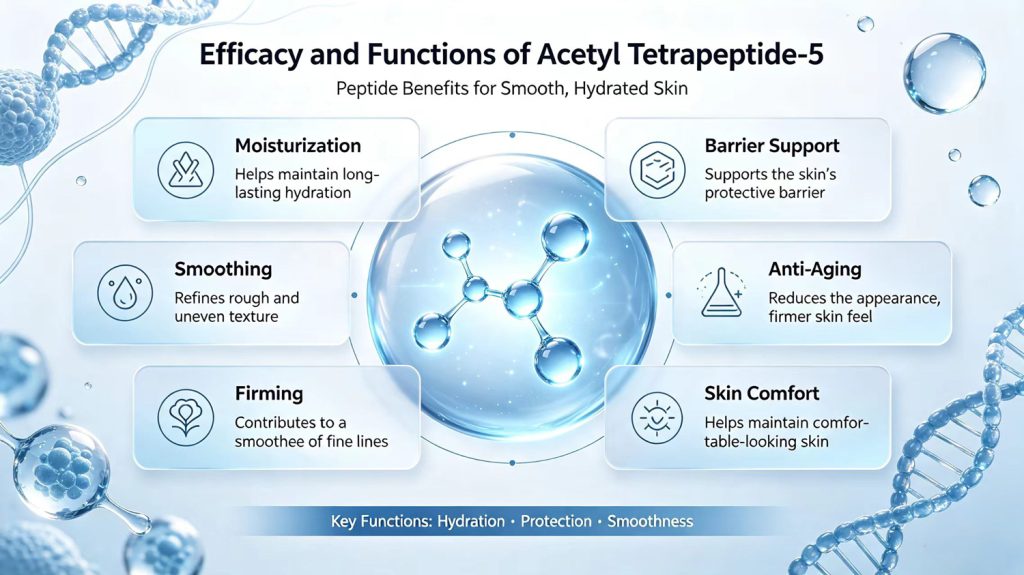
| Improves skin smoothness | Fine lines and uneven texture appear less noticeable | Supports a smoother, more hydrated-looking skin surface |
| Hydration support | Skin feels softer and less dry | Peptide-containing formulations can contribute to skin-conditioning and moisture retention |
| Anti-fatigue appearance | Eye area looks fresher | Particularly useful in products marketed for tired-looking eyes |
| Anti-aging support | Helps improve the overall appearance of mature skin | Used as part of multifunctional peptide-based anti-aging systems |
2. Under-eye puffiness
This is one of the most important cosmetic applications of Acetyl Tetrapeptide-5. The peptide is frequently positioned as an eye-contour active because puffiness can result from fluid accumulation in the delicate tissue surrounding the eyes.
By helping improve the appearance associated with fluid retention and tissue swelling, formulations containing Acetyl Tetrapeptide-5 may make the eye contour look less puffy and more defined.
Importantly, this should be described as a cosmetic improvement in appearance, rather than treatment of clinically significant edema.
3. Dark-circle improvement
Acetyl Tetrapeptide-5 is also used in products targeting dark circles.
Under-eye darkness is multifactorial. It can arise from:
- vascular visibility through thin skin;
- pigmentation;
- shadows produced by tear-trough anatomy;
- skin thinning associated with aging;
- puffiness and fluid accumulation.
Therefore, Acetyl Tetrapeptide-5 should not be regarded as a universal depigmenting ingredient. Its principal value is generally associated with the puffiness/fluid-retention component of the tired-eye appearance, rather than directly inhibiting melanin production like classic brightening agents.
4. Smoothing and anti-aging effects
Acetyl Tetrapeptide-5 is often incorporated into broader anti-aging and eye-care formulations.
Its use can complement ingredients such as:
- hyaluronic acid;
- peptides;
- ceramides;
- niacinamide;
- antioxidants;
- caffeine;
- vitamin C derivatives.
The resulting formulation can target several visible signs of aging simultaneously, including dryness, fine lines, uneven texture, puffiness, and dullness.
5. Skin-conditioning and hydration-related benefits
Another practical function is improving the overall appearance and feel of the skin. The eye contour has relatively thin and delicate skin, so maintaining hydration is important for minimizing the visual prominence of fine lines.
Acetyl Tetrapeptide-5 is therefore often used in moisturizing eye creams, gels, serums, and multi-active anti-aging products.
However, it is important to distinguish the peptide’s role from that of a dedicated humectant such as hyaluronic acid. Acetyl Tetrapeptide-5 is primarily an active peptide, not a conventional bulk moisturizing agent.
6. Why it is particularly suitable for eye products
The eye area is a logical target because it commonly exhibits several concerns simultaneously:
fluid accumulation → puffiness → shadows/dark appearance → tired-looking eyes
Acetyl Tetrapeptide-5 is marketed to address several of these visual concerns within one active ingredient, making it particularly attractive for:
- eye creams;
- eye gels;
- eye serums;
- anti-fatigue skincare;
- dark-circle products;
- anti-puffiness products;
- anti-aging formulations.

7. Evidence strength and limitations
A key point when evaluating Acetyl Tetrapeptide-5 is that commercial claims can be stronger than the publicly available independent clinical evidence. Much of the ingredient’s reputation comes from cosmetic ingredient-development and supplier-associated testing rather than a large body of independent, peer-reviewed clinical trials.
Consequently, claims such as “reduces puffiness,” “improves dark circles,” and “smooths the eye contour” are best interpreted as cosmetic-performance claims rather than established therapeutic effects.
Bottom line
The principal functions of Acetyl Tetrapeptide-5 can be summarized as:
- Anti-puffiness: helps improve the appearance of swollen under-eye tissue.
- Dark-circle support: may make certain types of under-eye darkness appear less pronounced.
- Eye-contour smoothing: contributes to a smoother, fresher-looking eye area.
- Anti-fatigue appearance: helps reduce the visual signs associated with tired-looking eyes.
- Anti-aging support: complements other actives targeting fine lines and skin aging.
- Skin conditioning: contributes to a more hydrated and comfortable-looking skin surface.
Overall, Acetyl Tetrapeptide-5 is best viewed as a specialized eye-contour cosmetic peptide, with its strongest positioning around puffiness, dark-circle appearance, and tired-looking eyes, rather than as a general-purpose collagen-stimulating peptide.