

Acetyl Tetrapeptide-5 is a synthetic tetrapeptide widely used as a cosmetic active ingredient, particularly in products targeting under-eye puffiness, dark circles, and signs of fatigue.
It belongs to the class of signal/functional peptides used in modern skincare. The peptide is designed to influence biological processes associated with fluid accumulation, skin appearance, and extracellular-matrix-related functions.
In cosmetic ingredient lists, it is generally identified by the INCI name Acetyl Tetrapeptide-5.
1. Origin
Acetyl Tetrapeptide-5 is not typically obtained directly from plants or animals. It is produced through controlled chemical or biochemical peptide synthesis.
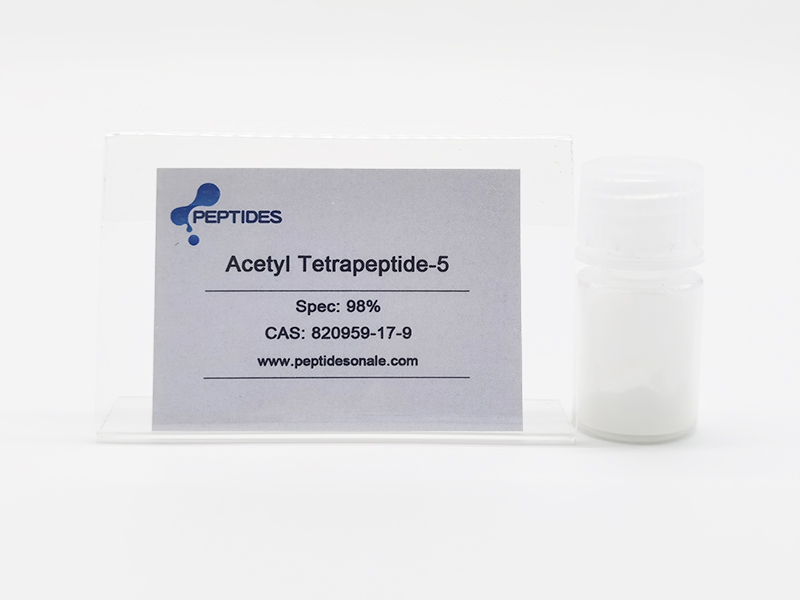
Its development is associated with cosmetic peptide technology, where short peptide sequences are engineered or selected for specific cosmetic effects. Commercial Acetyl Tetrapeptide-5 is generally supplied as a purified peptide or as part of a standardized peptide-containing solution.
A commonly marketed ingredient based on Acetyl Tetrapeptide-5 is Eyeseryl®, an eye-contour active developed for improving the appearance of puffiness and dark circles. The exact composition and supporting ingredients of commercial preparations can vary by supplier.
2. Chemical Nature
Acetyl Tetrapeptide-5 consists of:
- Acetyl group: an N-terminal acetyl modification
- Tetrapeptide: a chain containing four amino-acid residues
- Peptide bonds: link the amino acids together
- Synthetic origin: produced under controlled manufacturing conditions
The acetyl modification can alter the peptide’s stability, physicochemical behavior, and biological activity compared with the corresponding unacetylated peptide.
Because cosmetic peptides can be supplied in different forms or formulations, the purity, concentration, solvent system, and carrier ingredients should be evaluated from the supplier’s technical documentation rather than inferred from the peptide name alone.
3. Key Properties
| Property | Description |
| INCI name | Acetyl Tetrapeptide-5 |
| Category | Cosmetic peptide / functional tetrapeptide |
| Origin | Synthetic |
| Molecular type | Short-chain peptide |
| Main cosmetic focus | Eye contour, puffiness, tired-looking skin |
| Typical application | Eye creams, eye serums, facial serums |
| Target appearance | Under-eye bags, dark-circle appearance, fine lines |
| Formulation role | Active cosmetic ingredient |
| Typical use level | Depends strongly on the commercial raw material and supplier specification |
4. Main Cosmetic Characteristics
A. Eye-contour care
Acetyl Tetrapeptide-5 is particularly associated with eye-area formulations. The thin skin around the eyes can show fluid retention and fatigue-related changes more visibly than other facial areas.
B. Anti-puffiness positioning
One of its best-known cosmetic applications is reducing the appearance of under-eye bags and puffiness. This is why it is frequently incorporated into specialized eye-care products.
C. Dark-circle appearance
The ingredient is also marketed for improving the appearance of dark circles, although dark circles have multiple causes—including pigmentation, vascular visibility, shadows caused by anatomy, and skin thinning—so the peptide should not be regarded as a universal treatment for every type.
D. Skin-smoothing properties
Acetyl Tetrapeptide-5 is also used in formulations designed to make the eye area appear smoother and more refreshed.
E. Anti-aging applications
Because under-eye puffiness, fine lines, and tired-looking skin frequently occur together, Acetyl Tetrapeptide-5 is commonly incorporated into anti-aging and rejuvenating skincare systems.
5. How It Fits Into Modern Cosmetic Peptide Technology
Cosmetic peptides are generally divided into several functional categories:
- Signal peptides – intended to influence extracellular-matrix-related processes
- Carrier peptides – associated with delivery of metal ions or other functional components
- Neurotransmitter-related peptides – designed to influence processes associated with facial expression lines
- Enzyme-inhibitory peptides – intended to interfere with particular enzymatic pathways
- Specialized functional peptides – developed for particular cosmetic concerns
Acetyl Tetrapeptide-5 is best regarded as a specialized functional cosmetic peptide, with its strongest commercial positioning around the eye contour and the appearance of puffiness/dark circles.
6. Why It Is Popular in Eye-Care Products
The ingredient is attractive to formulators because it addresses several concerns that frequently occur in the same product:
Acetyl Tetrapeptide-5 → eye-contour care → reduced appearance of puffiness → smoother-looking skin → more refreshed appearance
It can therefore complement other eye-care ingredients such as:
- Hyaluronic acid
- Caffeine
- Niacinamide
- Peptides
- Ceramides
- Antioxidants
- Humectants
- Skin-brightening ingredients
Importantly, combining ingredients does not necessarily mean their effects are clinically synergistic; compatibility and formulation stability should be evaluated individually.
7. Important Distinction: Cosmetic Evidence vs. Medical Treatment
Acetyl Tetrapeptide-5 is primarily a cosmetic ingredient, not a pharmaceutical treatment.
Claims such as “eliminates eye bags,” “cures dark circles,” or “removes wrinkles” are considerably stronger than the evidence generally supports. Cosmetic formulations are more appropriately described as helping improve the appearance of puffiness, dark circles, or fine lines.
The actual performance depends on:
- Peptide concentration
- Raw-material quality
- Formulation pH
- Stability
- Delivery system
- Application frequency
- Duration of use
- Other active ingredients in the formula
- The underlying cause of the cosmetic concern
8. Summary
Acetyl Tetrapeptide-5 is a synthetic, short-chain cosmetic peptide developed primarily for eye-contour skincare. Its principal cosmetic positioning is around reducing the appearance of under-eye puffiness and dark circles while improving the smoothness and refreshed appearance of the eye area.
Its combination of a small peptide structure, specialized cosmetic activity, and suitability for eye creams and serums has made it a notable ingredient in modern peptide-based skincare. However, its effects should be interpreted as cosmetic appearance improvements rather than treatment of an underlying medical or anatomical condition.