

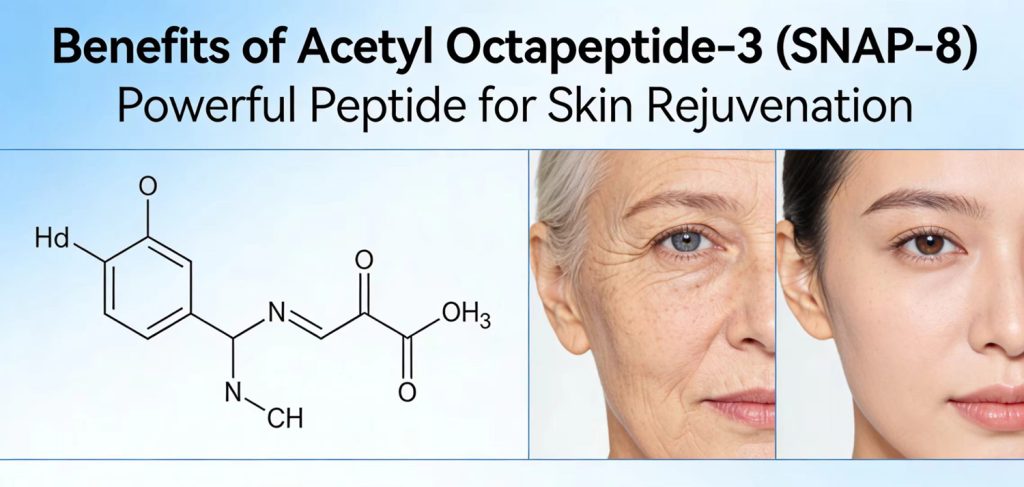
Acetyl Octapeptide-3 (often associated with “Argireline-type” peptides) is used in skincare mainly for its anti-wrinkle, muscle-relaxing cosmetic effects. Its benefits are modest but useful in topical anti-aging formulations.
Benefits of Acetyl Octapeptide-3
1. Reduces appearance of expression lines
It helps soften dynamic wrinkles caused by repeated facial movements, such as:
- Crow’s feet (eye area)
- Forehead lines
- Smile lines
This happens through a mild reduction in neurotransmitter signaling involved in muscle contraction.
2. Creates a smoother skin appearance
By slightly reducing micro-muscle contractions, it can make skin look:
- Less creased
- More relaxed
- Visibly smoother over time
3. Non-invasive “Botox-like” cosmetic effect
It is often used as a topical alternative conceptually similar to Botox, but:
- Much weaker
- Surface-level only
- Does not paralyze muscles
This makes it attractive for people avoiding injections.
4. Improves fine lines with consistent use
With regular application (usually weeks), it may:
- Reduce fine line depth
- Improve overall wrinkle visibility
- Support anti-aging routines when combined with moisturizers and peptides
5. Good compatibility with skincare formulas
It is generally:
- Well-tolerated on skin
- Easy to combine with hyaluronic acid, niacinamide, and other peptides
- Suitable for eye creams and serums
Important limitation (realistic expectation)
- Effects are mild and temporary
- It does not rebuild collagen significantly on its own
- Works best as part of a broader anti-aging routine, not as a standalone “wrinkle eraser”
If you want, I can compare its effectiveness directly with Acetyl Hexapeptide-8 (Argireline) or explain which one performs better in real cosmetic studies.